






How to Find a Reliable Electric Toothbrush OEM Manufacturer in China (2026)
The best sourcing channels for finding a reliable electric toothbrush OEM manufacturer in China are: (1) Trade shows like Canton Fair and HKTDC Electronics Fair for face-to-face vetting; (2) Direct Google search for factory websites with export experience; (3) Industry referrals from trusted brand owners. Key verification steps: cross-check business license on qichacha.com, verify ISO 9001 certificate number, request a live video factory walkthrough, and ask for client references. Minimum certifications: CE, FCC, RoHS, ISO 9001. Average sample costs: $30–$80 for catalog, $80–$200 for branded samples.
Executive Summary: Sourcing Electric Toothbrush OEMs in China
- Top Sourcing Channels: The most reliable channels for finding China-based oral care manufacturers include Tier-1 Trade Shows (Canton Fair), targeted Google searches for factory websites, and industry referrals.
- Global Compliance Verification: Legitimate OEMs must provide verifiable certifications for your target markets: FDA (USA), CE/RoHS (Europe), PSE (Japan), KC (South Korea), EAC (Russia), and TGA/RCM (Australia).
- The 20-Point Audit Rule: Never place a mass order without conducting a facility audit covering infrastructure (minimum 2,000m²), ISO 9001 quality control, in-house R&D capabilities, and commercial legitimacy.
- Critical Red Flags: Immediately walk away from suppliers who refuse live video walkthroughs, demand 100% upfront payment, or provide unverified certification copies.
Table of Contents
1. Why China for Electric Toothbrush OEM?
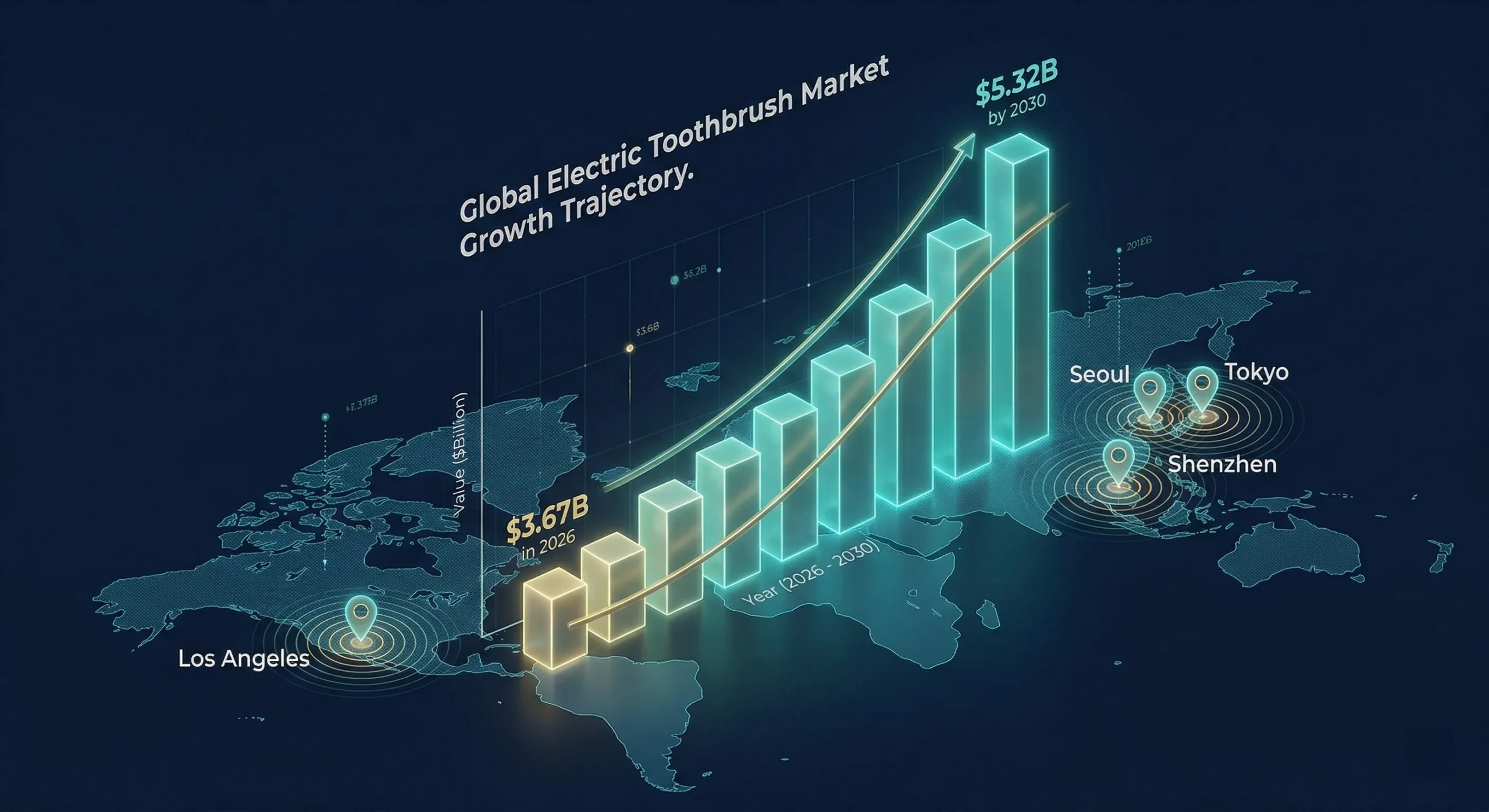
China manufactures approximately 75–80% of the world's electric toothbrushes, with the majority concentrated in Shenzhen's Longhua and Longgang districts. This dominance isn't just about low cost — it's about an ecosystem that no other country has yet replicated. The global electric toothbrush market was valued at USD 8.70 billion in 2024 and is projected to reach USD 70.15 billion by 2033, registering a CAGR of 26.1% [1]. This explosive market growth is largely served by China's manufacturing ecosystem.
Growing awareness of oral hygiene is a primary market driver. According to the American Dental Association (ADA), both manual and powered toothbrushes can be used effectively for oral care [2]. The World Health Organization (WHO) convened its first-ever Global Oral Health Meeting in November 2024 in Bangkok, highlighting the urgency of oral disease prevention globally [3]. According to the CDC, 47.2% of US adults aged 30+ have periodontal disease — a major driver of demand for effective electric toothbrushes [5].
- Complete supply chain depth: Motor suppliers (Mabuchi, Nidec equivalents), PCB fabs, injection molders, brush head manufacturers, and packaging suppliers all within 30–60 minutes of each other. This drives down lead times and BOM costs simultaneously.
- Certification experience: Shenzhen factories have handled CE, FCC, RoHS, PSE, and KC certifications for hundreds of brands. The institutional knowledge is irreplaceable.
- ODM platform maturity: Leading factories have invested $2M–$10M in existing platform R&D that ODM buyers can access for a fraction of that cost.
- Scale flexibility: MOQs from 500 units (ODM) to 50,000+ (high-volume OEM) within the same factory ecosystem.
📋 About the Manufacturer: Relish Technology
This guide is authored by Shenzhen Relish Technology Co, Ltd., a professional OEM/ODM manufacturer with 14+ years of export experience in the oral care industry. Our manufacturing capabilities: 20,000 m² dust-free workshop in Shenzhen · 1.2 million+ units monthly capacity · 300+ skilled workers across 12 automated production lines · 30+ R&D engineers · Products exported to 120+ countries · Certifications: CE, FCC, FDA, ISO 9001, RoHS, REACH. Learn more → | Client case studies → | View certifications →
📍 Where the factories are
The primary manufacturing clusters are in Shenzhen (Longhua, Longgang, Pinghu) et Dongguan. Some factories have moved production lines to inland provinces (Jiangxi, Hunan) for lower labor costs while keeping headquarters and R&D in Shenzhen. Always verify the actual production address, not just the registered office.
2. Six Sourcing Channels (Ranked by Quality)
Not all sourcing channels are equal. Here's an honest ranking based on the quality of factories you're likely to find through each. For a verified manufacturer shortcut, skip to Relish Technology's manufacturing profile →
1. Canton Fair / Trade Shows
The gold standard for first contact. You see factory representatives face-to-face, handle product samples, and assess professionalism in real time. Spring (April) and Autumn (October) sessions in Guangzhou.
2. Google Search (Factory Websites)
Factories that invest in English-language websites tend to be more export-experienced. Search terms like "electric toothbrush OEM manufacturer China" or "sonic toothbrush ODM factory" to find direct factory sites, not trading companies.
3. Alibaba / Made-in-China
Huge volume but mixed quality. Many listings are trading companies, not factories. Use "Verified Supplier" and "Assessed Supplier" filters. Request factory videos and audit reports. Useful for initial shortlisting.
4. Industry Referrals
Ask brand owners in adjacent categories (oral care accessories, beauty devices) who they manufacture with. A warm referral from a trusted source is worth 10 cold Alibaba leads. LinkedIn and e-commerce forums are good for this.
5. Sourcing Agents (Shenzhen-based)
Best for brands without China experience or language capability. A good agent provides factory introductions, translation, quality control, and logistics coordination. Fees: 3–8% of order value. Verify they don't earn undisclosed factory commissions.
6. Global Sources
Similar to Alibaba but historically higher quality listing standards and stronger verification. Hong Kong Electronics Fair (October) is excellent for meeting Global Sources suppliers in person.
3. First Contact: What to Ask in Your RFQ
Your Request for Quotation (RFQ) is your first signal to the factory about what kind of buyer you are. A vague RFQ gets a generic quote — and no serious factory's attention. Here's what to include:
Essential RFQ components
- Product type and specification: "Sonic electric toothbrush, rechargeable, IPX7 waterproof, 3 modes, USB charging" — be specific.
- Target markets: EU / USA / Japan / etc. This tells the factory which certifications apply.
- Estimated annual volume: Even a rough figure (5,000 / year) helps the factory assess whether you're worth a serious quotation.
- OEM or ODM intent: "Looking for ODM with custom packaging and color options" vs. "Full OEM with custom mold development."
- Timeline: "Target first shipment by Q3 2026."
- Request: Product catalog, existing certifications, current client references, and lead time for samples.
⚠️ Don't mention your target price too early
Stating a budget upfront causes factories to reverse-engineer their BOM to hit your number — often by quietly substituting components. Get the full spec quote first, then negotiate on volume and payment terms.
Evaluate the response quality
A factory worth working with will respond to your RFQ with: a product catalog with genuine specifications, their certification portfolio, a lead time estimate, a request for clarification on your requirements, and ideally, client case study examples. Factories that respond with just a price list and "we can do everything" are red flags.
4. 20-Point Factory Audit Checklist
Before placing a production order (not just a sample), complete this audit — either in person or via video call with live camera walk-through of the facility.
🏭 A. Facility & Infrastructure (5 Points)
📜 B. Certifications & Documentation (5 Points)
⚙️ C. Production Capability (5 Points)
🤝 E. Commercial & Communication (5 Points)
💡 Scoring Guide
18–20 points: Qualified for sample order. 14–17 points: Proceed with caution, verify critical gaps. 10–13 points: Significant risk — likely a trading company or under-resourced factory. Under 10: Walk away.
5. Eight Red Flags to Walk Away From
These are patterns that experienced sourcing professionals have learned — the hard way — to treat as disqualifying:
They can't show you the factory on a live video call
In 2026, a 30-minute live factory walkthrough via video call takes zero effort. Any factory unwilling to do this is either a trading company or has something to hide. Non-negotiable.
They ask for full payment upfront from a new buyer
Legitimate manufacturers accept 30% deposit, 70% before shipment (T/T) — or LC for large orders. Full prepayment from a stranger is a classic fraud signal.
Certifications are copies without verifiable certificate numbers
CE and FCC certificates have unique numbers that you can verify directly with the issuing body or certification lab. A factory presenting non-verifiable cert copies is either lying or their certs have been revoked.
Price is 30%+ lower than all other quotes
Electric toothbrush BOM costs have a floor. A quote dramatically below market typically means: substitute components, short-cutting QC, or the sample is good but mass production isn't. "Race to the bottom" factories exist specifically to win the sample order, then cut corners on production.
No English-speaking technical contact
Sales can use translation tools. But product specifications, QC feedback, and problem-solving during production require a technical point of contact who can understand and respond to detailed requirements. Without this, your OEM project will fail specification reviews.
They discourage you from doing a pre-shipment inspection
Any factory that resists third-party inspection (SGS, Intertek, QIMA) before you release final payment is hiding a quality issue. A confident, quality manufacturer welcomes inspection — it protects their reputation too.
They claim to manufacture everything: toothbrushes, beauty devices, toys, electronics
Specialization correlates with quality in manufacturing. A factory claiming expertise in 15 unrelated product categories is almost certainly a trading company with no actual production capability.
Payment requested to a personal bank account
All legitimate B2B payments should go to a corporate bank account in the factory's registered company name. Any request to pay to a personal account or a different company name is fraud risk — full stop.
6. Sample Order Process
Never skip the sampling stage, regardless of how good a factory looks on paper. The sample process is your real due diligence.
Catalog Sample (Free or $50–$80)
Request an existing stock sample from the factory's current platform. This tests their packing, shipping, and basic product quality. Pay sample cost + shipping; do not accept "free sample" that includes freight via DHL as the factory absorbs cost — it creates unspoken obligation.
Branded Sample (Custom color/logo)
Once catalog sample passes your basic quality check, request a sample with your branding applied. This tests the factory's ability to execute your specifications — logo placement, color accuracy, packaging fit. Cost: $80–$200 per sample including customization.
Pre-Production Sample (Golden Sample)
Before mass production begins, require a pre-production sample that exactly matches what will be manufactured. Both parties sign off on this as the quality benchmark. Any deviation in mass production can be measured against this standard. Store copies of the golden sample.
First Article Inspection (Pre-shipment)
Before releasing final payment, commission a third-party inspection (QIMA, SGS, Intertek — $200–$400 per inspection). Inspector tests 20–30 units against your golden sample and product specification. Pass rate ≥98% is standard for release.
7. Negotiation: Price, MOQ & Payment Terms
Price negotiation levers
Electric toothbrush pricing has genuine floor costs — a sonic toothbrush with IPX7, 3 modes, and USB charging has a BOM cost of $8–$15 depending on motor and battery spec. Factories will negotiate on margin, not on BOM. Effective negotiation levers:
- Volume commitment: Commit to annual volume (even non-binding) in exchange for better unit pricing.
- Payment terms: Offering LC (letter of credit) or reduced payment terms can get you 5–8% better pricing.
- Tooling ownership: If you're paying for molds, negotiate a lower per-unit production cost since the factory's tooling risk is eliminated.
- Packaging simplification: Reducing packaging SKU complexity (fewer language versions, simpler insert design) saves cost without compromising product quality.
Standard payment terms for first-time buyers
| Order Stage | Standard Terms | Acceptable Negotiated Terms |
|---|---|---|
| Sample order | 100% upfront | 100% upfront (non-negotiable) |
| First production order (under $20K) | 30% deposit, 70% before shipment | 50% after sample approval, 50% before shipment |
| Repeat orders (established relationship) | 30% deposit, 70% before shipment | 30% deposit, 70% upon bill of lading |
| Large orders ($50K+) | 30% deposit, 70% before shipment | Letter of Credit (LC) — factory ships, bank releases payment on document presentation |
8. Contract Essentials
A purchase order alone is not sufficient protection. For OEM relationships, insist on a formal manufacturing agreement that covers:
- IP ownership clause: All molds, tooling, and design files created for your project are your property. Factory cannot use them for other clients.
- NDA (Non-Disclosure Agreement): Signed before you share design files, brand guidelines, or product specifications.
- Quality standards reference: Golden sample and product specification sheet are incorporated by reference as binding quality benchmarks.
- Defect rate and remedy: Define acceptable AQL levels (typically AQL 2.5 for critical defects, 4.0 for major) and the factory's obligation to replace or refund out-of-spec goods.
- Delivery schedule and penalties: Clear ship-by dates with explicit financial penalty for delay (typically 0.5% of order value per week).
- Jurisdiction: Prefer international arbitration (ICC or HKIAC) over Chinese domestic courts for dispute resolution.
⚠️ Register your trademarks in China before sharing your brand
China uses a first-to-file trademark system. If you share your brand name and logo with factories before filing a Chinese trademark, a bad-faith actor could register your mark in China, blocking you from importing your own products. File your trademark with CNIPA before any factory engagement. Process takes 12–18 months; apply early.
9. Frequently Asked Questions
Talk to a Verified OEM Manufacturer Directly
Relish Technology is a Shenzhen-based oral care OEM/ODM factory with 14+ years of export experience. 20,000 m² facility · 1.2M+ units/month capacity · CE, FCC, RoHS, and ISO 9001 certified. MOQ from 500 units. See client case studies →
Request a Factory Quote Read the Full OEM GuideRéférences
- [1] Straits Research. (2025). Electric Toothbrush Market Size, Share & Trends Analysis Report, 2025–2033. Retrieved from https://straitsresearch.com/report/electric-toothbrush-market. Market valuation: USD 8.70 billion (2024); Projected: USD 70.15 billion (2033); CAGR: 26.1%.
- [2] American Dental Association. (2024). Toothbrushes: Oral Health Topics. Retrieved from https://www.ada.org/resources/research/science-and-research-institute/oral-health-topics/toothbrushes. ADA recommends powered toothbrushes can be used effectively for oral care.
- [3] World Health Organization. (2024). Oral Health — Global Oral Health Meeting 2024. Retrieved from https://www.who.int/health-topics/oral-health. WHO convened first-ever Global Oral Health Meeting, Bangkok, November 2024.
- [4] Delta Dental Plans Association. (2023). State of America's Oral Health and Wellness Report. Retrieved from https://www.deltadental.com/us/en/member-resources/our-company/press-room/press-releases/state-of-oral-health-2023.html. 92% of US adults regard oral health as very or extremely vital to overall health.
- [5] Centers for Disease Control and Prevention (CDC). (2023). Periodontal Disease Prevalence and Risk Factors. Retrieved from https://www.cdc.gov/oral-health/fast-facts-in-oral-health/index.html. 47.2% of US adults aged 30+ have periodontal disease; 65 million adults total; 79% of adults aged 65+.