










Cumplimiento normativo de los cepillos de dientes eléctricos en Amazon: Guía de requisitos 2026
El cumplimiento de cepillos de dientes eléctricos en Amazon implica requisitos de la FDA, la FCC, UL y requisitos específicos de la categoría de Amazon. Navegue por el panorama regulatorio completo, evite la suspensión de la cuenta y cree un listado conforme desde el primer día con esta guía paso a paso.
Conclusiones clave
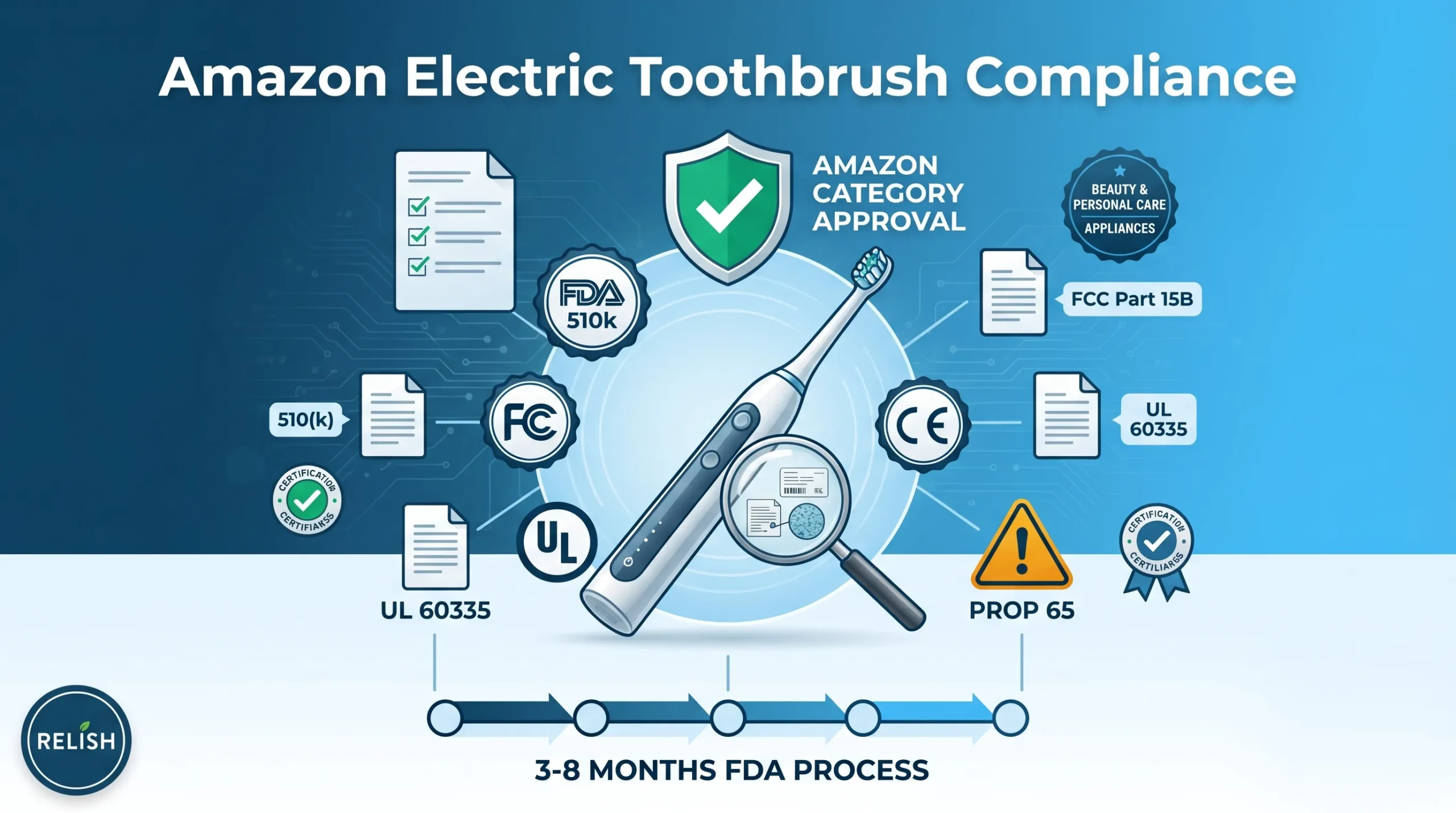
- Los cepillos de dientes eléctricos son dispositivos médicos de Clase II según la clasificación de la FDA y requieren autorización 510(k) para la venta en EE. UU.
- La FCC Parte 15B se aplica a todos los cepillos de dientes eléctricos; se requiere certificación FCC para modelos Bluetooth/inalámbricos
- La aprobación de la categoría de Electrodomésticos de Belleza y Cuidado Personal de Amazon requiere la presentación de documentación de cumplimiento
- La divulgación de la Proposición 65 de California es obligatoria para productos vendidos a consumidores de California — pruebe o etiquete
- La suspensión de la cuenta por cumplimiento de cepillos de dientes eléctricos en Amazon infracciones cuesta un promedio de $5,000–$15,000 en inventario perdido y honorarios legales
- Trabaje con un fabricante OEM que ya posea archivos técnicos de la FDA 510(k) para optimizar su cumplimiento de cepillos de dientes eléctricos en Amazon cronograma y costo
Cada mes, Amazon suspende docenas de cuentas de vendedores por vender dispositivos de cuidado bucal no conformes (Informes de Rendimiento de Vendedores de Amazon, 2025). El patrón es consistente con fallas en cumplimiento de cepillos de dientes eléctricos en Amazon: un nuevo vendedor adquiere un cepillo de dientes eléctrico de un fabricante chino, lo lista en Amazon, comienza a generar ventas — y luego recibe un aviso de suspensión de cuenta citando incumplimiento de la FDA o falta de documentación de seguridad eléctrica.
El costo es severo: inventario incautado, ingresos perdidos durante la suspensión, honorarios legales para apelar y, en algunos casos, cierre permanente de la cuenta. Para cumplimiento de cepillos de dientes eléctricos en Amazon, el panorama es complejo — combinando la regulación de dispositivos médicos de la FDA de EE. UU., los requisitos de compatibilidad electromagnética de la FCC, las pruebas de seguridad eléctrica y las políticas específicas de categoría de Amazon. Comprender cada capa es esencial antes de que su primer envío llegue a un puerto de EE. UU.
Por qué el Cumplimiento es Innegociable en Amazon
Comprender cumplimiento de cepillos de dientes eléctricos en Amazon comienza reconociendo que Amazon opera tanto como un mercado como una capa de aplicación regulatoria. Mientras que la FDA establece la línea base legal para el cumplimiento del dispositivo, los términos de servicio de Amazon requieren que los vendedores certifiquen que sus productos cumplen con "todas las leyes y regulaciones aplicables" — y Amazon tiene sus propios equipos internos que verifican esto. Los vendedores que tratan cumplimiento de cepillos de dientes eléctricos en Amazon como algo secundario enfrentan constantemente costosas remediaciones.
La Cadena Regulatoria para Cepillos de Dientes Eléctricos
Un cepillo de dientes eléctrico vendido en Amazon pasa por múltiples puntos de control de cumplimiento — cada uno de los cuales puede terminar su listado si cumplimiento de cepillos de dientes eléctricos en Amazon está incompleto:
- Aduanas y Protección Fronteriza de EE. UU. (CBP): Los cepillos de dientes eléctricos importados son detenidos en el puerto de entrada si el importador no puede proporcionar documentación de la FDA 510(k). CBP y FDA comparten datos de forma continua.
- Vigilancia del Mercado de la FDA: La Oficina de Asuntos Regulatorios de la FDA monitorea los listados del mercado para el cumplimiento de dispositivos médicos. Los cepillos de dientes eléctricos son una prioridad de aplicación conocida.
- Aplicación de Categoría de Amazon: Amazon requiere documentación antes de habilitar la categoría de Electrodomésticos de Belleza y Cuidado Personal para la cuenta de un vendedor. Esto es una puerta, no una sugerencia.
- Informes de Seguridad del Consumidor: Los informes de eventos adversos presentados a la FDA pueden desencadenar investigaciones de productos que se extienden a las eliminaciones de Amazon.
Requisitos de la FDA para Cepillos de Dientes Eléctricos
El componente de la FDA de cumplimiento de cepillos de dientes eléctricos en Amazon es el más complejo. La FDA clasifica los cepillos de dientes eléctricos como dispositivos médicos de Clase II bajo 21 CFR Parte 872 (Dispositivos Dentales). El código de producto aplicable es "JWJ" para cepillos de dientes eléctricos. Esta clasificación ha estado vigente desde 1972, y existen numerosos dispositivos predicados establecidos a los que las nuevas presentaciones pueden hacer referencia.
Notificación Previa a la Comercialización 510(k) vs. Registro de Instalaciones
Estos son dos procesos separados de la FDA que los nuevos vendedores confunden con frecuencia:
| Requisito | Registro de Instalaciones | Autorización 510(k) |
|---|---|---|
| Qué es | Listar su instalación de fabricación ante la FDA | Revisión previa a la comercialización que demuestra que su dispositivo es sustancialmente equivalente a un predicado |
| Base legal | 21 CFR Parte 807 | 21 CFR Parte 807, Subparte E |
| Quién presenta | Agente en EE. UU. o fabricante extranjero | Propietario de la marca o fabricante (preferido) |
| Cronología | 1–3 días (registro en línea) | 3–8 meses |
| Costo | $5,226–$6,490/año (2026) | $10,000–$35,000 (consultor + pruebas) |
| ¿Requerido para Amazon? | Altamente recomendado | Sí — requerido |
| ¿Es suficiente por sí solo? | No — el registro no equivale a la autorización | Sí — la autorización incluye el registro |
¿Todo cepillo de dientes eléctrico necesita autorización 510(k)?
Sí, todo cepillo de dientes eléctrico que ingrese al comercio de EE. UU. requiere autorización 510(k) — sin excepción. La posición de la FDA es clara: cualquier dispositivo que esté "destinado a ser utilizado en el diagnóstico de enfermedades u otras condiciones, o en la cura, mitigación, tratamiento o prevención de enfermedades" es un dispositivo médico sujeto a los requisitos 510(k). El uso previsto de un cepillo de dientes eléctrico — "limpiar los dientes" — cae directamente dentro de esta definición. (Para la entrada al mercado de la UE, consulte nuestra guía de certificación CE para cepillos de dientes eléctricos.)
El proceso 510(k) requiere demostrar "equivalencia sustancial" con un dispositivo de referencia comercializado legalmente. Para cepillos de dientes eléctricos, los dispositivos de referencia comunes incluyen:
- Philips Sonicare Essence y modelos Sonicare posteriores
- Oral-B Pro-Health y modelos Oral-B posteriores
- Waterpik Sensonic y marcas establecidas similares
La presentación 510(k) incluye: descripción del dispositivo, especificaciones técnicas, lista de materiales, usos previstos propuestos, comparación con el dispositivo de referencia e informes de prueba (biocompatibilidad, seguridad eléctrica, compatibilidad electromagnética). Un fabricante OEM certificado como Relish Tech mantiene archivos técnicos 510(k) precompilados para modelos estándar que pueden adaptarse para su marca — reduciendo su cumplimiento de cepillos de dientes eléctricos en Amazon cronograma de 8 meses a 3–4 meses.
Certificación de la FCC
La certificación FCC es un pilar crítico de cumplimiento de cepillos de dientes eléctricos en Amazon. La Comisión Federal de Comunicaciones regula las emisiones electromagnéticas de dispositivos electrónicos bajo la Ley de Comunicaciones de 1934. Todos los cepillos de dientes eléctricos — con cable o recargables — emiten energía electromagnética y están bajo la jurisdicción de la FCC.
FCC Parte 15: Radiadores no intencionales vs. Radiadores intencionales
Los requisitos de la FCC se dividen en dos categorías según si el dispositivo emite intencionalmente energía de radiofrecuencia:
| Tipo de dispositivo | Requisito FCC | Estándar de prueba | Cronología | Rango de Costo |
|---|---|---|---|---|
| Cepillo de dientes sin conexión inalámbrica | FCC SDoC (Declaración de Conformidad del Proveedor) | FCC Parte 15B | 1–3 semanas | $1,500–$3,000 |
| Cepillo de dientes Bluetooth/inalámbrico | Certificación FCC (revisión por TCB requerida) | FCC Parte 15B + 15.247 | 3-6 semanas | $4,000–$10,000 |
FCC SDoC permite al fabricante autodeclarar el cumplimiento después de las pruebas en un laboratorio acreditado. La certificación FCC requiere la presentación a un Organismo de Certificación de Telecomunicaciones (TCB) — típicamente un laboratorio privado autorizado por la FCC — que revisa los informes de prueba y emite la certificación. Para obtener orientación completa sobre abastecimiento regulatorio, consulte nuestra Guía de abastecimiento de cuidado oral desde China.
Pruebas de seguridad eléctrica
La certificación de seguridad eléctrica es el tercer pilar de cumplimiento de cepillos de dientes eléctricos en Amazon. Más allá de la compatibilidad electromagnética FCC, los cepillos de dientes eléctricos deben cumplir con los estándares de seguridad eléctrica para el mercado estadounidense. El estándar principal es UL 60335-1 (Seguridad de electrodomésticos), que cubre descargas eléctricas, incendios, lesiones mecánicas y riesgos térmicos.
UL vs. ETL vs. Certificación CSA
UL (Underwriters Laboratories), ETL (Intertek) y CSA (Canadian Standards Association) son Laboratorios de Prueba Reconocidos a Nivel Nacional (NRTL) aprobados por OSHA para probar y certificar productos para el cumplimiento de seguridad en el mercado de EE. UU. Cualquiera de estas marcas es aceptable para el cumplimiento de Amazon:
- UL Listed: La marca de seguridad original y más reconocida. Las pruebas son rigurosas y exhaustivas.
- ETL Listed: La marca de Intertek, equivalente en aceptación a UL. A menudo más rápida y menos costosa.
- CSA Listed: De origen principalmente canadiense pero aceptada en EE. UU. Común en productos con distribución dual en el mercado norteamericano.
| Componente de Prueba | Estándar | Lo que Cubre | Fallas de Muestra |
|---|---|---|---|
| Resistencia Dieléctrica al Voltaje | UL 60335-1 Cláusula 13 | Integridad del aislamiento a alto voltaje | Ruptura bajo 1,500V CA |
| Corriente de Fuga | UL 60335-1 Cláusula 13 | Corriente que escapa del dispositivo | Supera el umbral de 0.5mA |
| Prueba de Impermeabilidad IPX | IEC 60529 | Nivel de protección contra ingreso de agua | Humedad en el compartimento de la batería |
| Prueba de caída | UL 60335-1 | Seguridad después de caídas simuladas | Desprendimiento de la batería, exposición de partes vivas |
| Seguridad de Batería (Li-ion) | IEC 62133 / UL 62133 | Seguridad de la celda bajo condiciones de abuso | Fuga térmica, riesgo de explosión |
Proposición 65 de California
El cumplimiento de la Prop 65 a menudo se pasa por alto en la cumplimiento de cepillos de dientes eléctricos en Amazon planificación, sin embargo, puede generar costosas demandas de ejecución privada. La Ley de Agua Potable Segura y Control de Sustancias Tóxicas de 1986 (Proposición 65) requiere que las empresas en California proporcionen advertencias "claras y razonables" antes de exponer a los consumidores a químicos conocidos por causar cáncer, defectos de nacimiento u otros daños reproductivos. La lista actualmente incluye más de 900 químicos.
Los cepillos de dientes eléctricos presentan riesgos de exposición a la Prop 65 por:
- Baterías de iones de litio: Pueden contener níquel, cobalto u otros compuestos listados
- Componentes plásticos: BPA (bisfenol A) en piezas de policarbonato — listado en la Proposición 65 desde 2005
- Materiales de PCB: Plomo y cadmio en soldadura y materiales de placas de circuito
- Componentes de aleación metálica: Níquel en cabezales de cepillo de acero inoxidable — listado bajo la Prop 65
El cumplimiento con la Prop 65 requiere uno de dos enfoques: (1) Pruebas de producto por un laboratorio acreditado por la Prop 65 de California para determinar si algún químico listado excede los niveles de Puerto Seguro, o (2) Advertencias de la Prop 65 en el empaque del producto que indiquen que el producto contiene químicos conocidos por causar cáncer o daños reproductivos. El formato de advertencia está prescrito por las regulaciones de la Proposición 65 y debe incluir el símbolo de "advertencia" (triángulo amarillo con un signo de exclamación). Ambos enfoques son aceptados para cumplimiento de cepillos de dientes eléctricos en Amazon fines, pero las pruebas son preferidas si tiene la intención de reclamar una posición de "no se requiere advertencia".
Requisitos Específicos de Categoría de Amazon
La capa final de cumplimiento de cepillos de dientes eléctricos en Amazon es la propia puerta de aprobación de categoría de Amazon. Más allá de FDA, FCC y Prop 65, Amazon aplica sus propios requisitos de cumplimiento a través del proceso de aprobación de categoría. Los cepillos de dientes eléctricos caen bajo la Electrodomésticos de Belleza y Cuidado Personal categoría (categoría BCA).
Proceso de Aprobación de Categoría en Amazon
Documentos requeridos para la aprobación de la categoría Beauty & Personal Care Appliances — todos los cuales forman el núcleo de un expediente cumplimiento de cepillos de dientes eléctricos en Amazon completo:
- Carta de autorización 510(k) de la FDA (o número de registro de establecimiento de la FDA — aunque se prefiere firmemente la 510(k))
- Informe de prueba FCC o SDoC de un laboratorio acreditado
- Informe de prueba UL/ETL/CSA para seguridad eléctrica
- Imágenes del producto que muestren el dispositivo y todos los lados del empaque minorista
- Manual de usuario con instrucciones de seguridad y declaración de uso previsto
- Documentación de cumplimiento de California Prop 65 (informes de prueba o imágenes de etiquetas de advertencia)
¿Listo para Construir tu Listado de Amazon Cumplidor?
El equipo de cumplimiento de Relish Tech maneja completo cumplimiento de cepillos de dientes eléctricos en Amazon — FDA 510(k), FCC, UL y aprobación de categoría de Amazon — de principio a fin. MOQ desde 1,000 unidades con paquete de documentación completo incluido.
Cómo Relish Tech Apoya el Cumplimiento
Relish Tech ha desarrollado paquetes cumplimiento de cepillos de dientes eléctricos en Amazon estandarizados que simplifican drásticamente el proceso de cumplimiento de Amazon FBA:
- Archivos Técnicos 510(k) Precompilados: Nuestros modelos estándar de cepillos de dientes ODM vienen con archivos técnicos adaptables de la FDA 510(k) que reducen tu plazo de autorización a 3–4 meses y el costo a $8,000–$15,000 (frente a 8+ meses y $25,000–$35,000 desde cero)
- Informes de Prueba FCC y UL: Cada producto de Relish Tech se envía con informes de prueba actuales de FCC Parte 15B y certificación de seguridad eléctrica UL 60335-1 de laboratorios acreditados
- Informes de Prueba Prop 65: Pre-evaluamos todos los modelos para los umbrales químicos de la Proposición 65 y proporcionamos certificados de cumplimiento
- Paquete de Documentación de Amazon: Compilamos toda la documentación de cumplimiento en un formato listo para Amazon para tu envío de aprobación de categoría
- Servicio de Agente de la FDA de EE. UU.: Para fabricantes extranjeros, proporcionamos representación de Agente de la FDA de EE. UU. requerida para el registro de establecimiento y envíos 510(k)
Trabajar con un fabricante que ya ha completado las pruebas regulatorias para tu plataforma de producto elimina los retrasos más cumplimiento de cepillos de dientes eléctricos en Amazon comunes y reduce el riesgo de incumplimiento que lleva a la suspensión de la cuenta de Amazon.
Elementos Esenciales de Abastecimiento OEM
1,000–2,000 unidades por modelo
60–120 días incl. preparación de cumplimiento
Validación IQ/OQ/PQ · AQL 0/2.5
FDA 510(k) · FCC · UL 60335-1 · Prop 65
¿Necesita soporte de cumplimiento normativo para su marca de cepillos de dientes eléctricos?
El equipo regulatorio de Relish Tech gestiona el cumplimiento de cepillos de dientes eléctricos en Amazon — FDA 510(k), FCC, UL y documentación de cumplimiento de categoría de Amazon. Hemos apoyado a más de 500 marcas de cuidado bucal durante todo el proceso de cumplimiento (datos internos de la marca).
Solicite una consultoría de cumplimiento normativoPreguntas frecuentes
Estas son las preguntas más comunes que los compradores B2B y propietarios de marcas hacen sobre cumplimiento de cepillos de dientes eléctricos en Amazon. Cada respuesta refleja los requisitos regulatorios a partir de 2026 y la experiencia práctica de Relish Tech apoyando a más de 500 marcas de cuidado bucal en los procesos de aprobación de FDA, FCC y Amazon. Si su cumplimiento de cepillos de dientes eléctricos en Amazon escenario específico no está cubierto, contacte directamente a nuestro equipo regulatorio.
Referencias
- Administración de Alimentos y Medicamentos de EE. UU. (2026). Notificación previa a la comercialización 510(k) — Cepillos de dientes eléctricos (Código de producto: JWJ). Obtenido de fda.gov
- Administración de Alimentos y Medicamentos de EE. UU. (2026). Registro de establecimiento y listado de dispositivos — 21 CFR Parte 807. Obtenido de fda.gov
- Comisión Federal de Comunicaciones. (2025). FCC Parte 15 — Dispositivos de radiofrecuencia. Obtenido de fcc.gov
- Underwriters Laboratories. (2025). UL 60335-1 — Seguridad de aparatos electrodomésticos y aparatos eléctricos similares. Obtenido de ul.com
- Oficina de Evaluación de Riesgos Ambientales para la Salud de California. (2026). Proposición 65 — Lista de sustancias químicas que causan cáncer o toxicidad reproductiva. Obtenido de oehha.ca.gov
- Centro de vendedores de Amazon. (2026). Requisitos de aprobación de categoría de electrodomésticos de belleza y cuidado personal. Obtenido de sellercentral.amazon.com
- Comisión Electrotécnica Internacional. (2024). IEC 62133-2 — Celdas secundarias y baterías que contienen electrolitos alcalinos u otros no ácidos. Obtenido de iec.ch