











How Electric Toothbrushes Work:
Complete Technical Guide 2026
From magnetic coil drivers and DC gear motors to AI-powered brushing analysis — a manufacturer's deep-dive into the engineering, physics, and manufacturing behind modern electric toothbrushes.
* Compared with manual toothbrush use. Sonic toothbrushes have been shown in clinical studies to remove significantly more plaque than manual brushing.
Electric toothbrushes are deceptively complex machines. At their core, they combine precision motors, intelligent control systems, rechargeable power sources, and ergonomic design into a device that fits in the palm of your hand — yet performs tens of thousands of precise mechanical movements per brushing session. This guide breaks down exactly how electric toothbrushes work, from the physics of sonic vibration to the engineering decisions that shape OEM manufacturing.
Wichtigste Erkenntnisse
- Understanding how electric toothbrushes work starts with the three core technology categories: sonic (magnetic coil vibration), rotating-oscillating (DC motor rotation), and combination (dual-action systems like Rotasonic™)
- Sonic toothbrushes generate cleaning action both through bristle contact und fluid dynamics — the agitation of toothpaste and saliva reaches interproximal areas bristles cannot
- The core electronic components — PCB, motor driver, BLE module, pressure sensor — are all miniaturized and waterproofed to IPX7 standards
- Battery technology (Li-ion vs NiMH) directly impacts weight, runtime, and charging time, all critical OEM decision points
- Pressure sensors use piezoresistive or capacitive technology to detect excessive brushing force and prevent gum damage in real time
- Smart toothbrushes add BLE SoC + companion app but the core brushing mechanism is identical to non-smart models
- How electric toothbrushes work from an OEM manufacturing perspective: motor type, battery capacity, and smart features drive BOM cost — not branding or brush head quality
- Vibrosonic™ technology achieves up to 48,000 strokes/min with a secondary harmonic layer that enhances fluid cleaning beyond standard sonic
The Three Core Technologies of Electric Toothbrushes
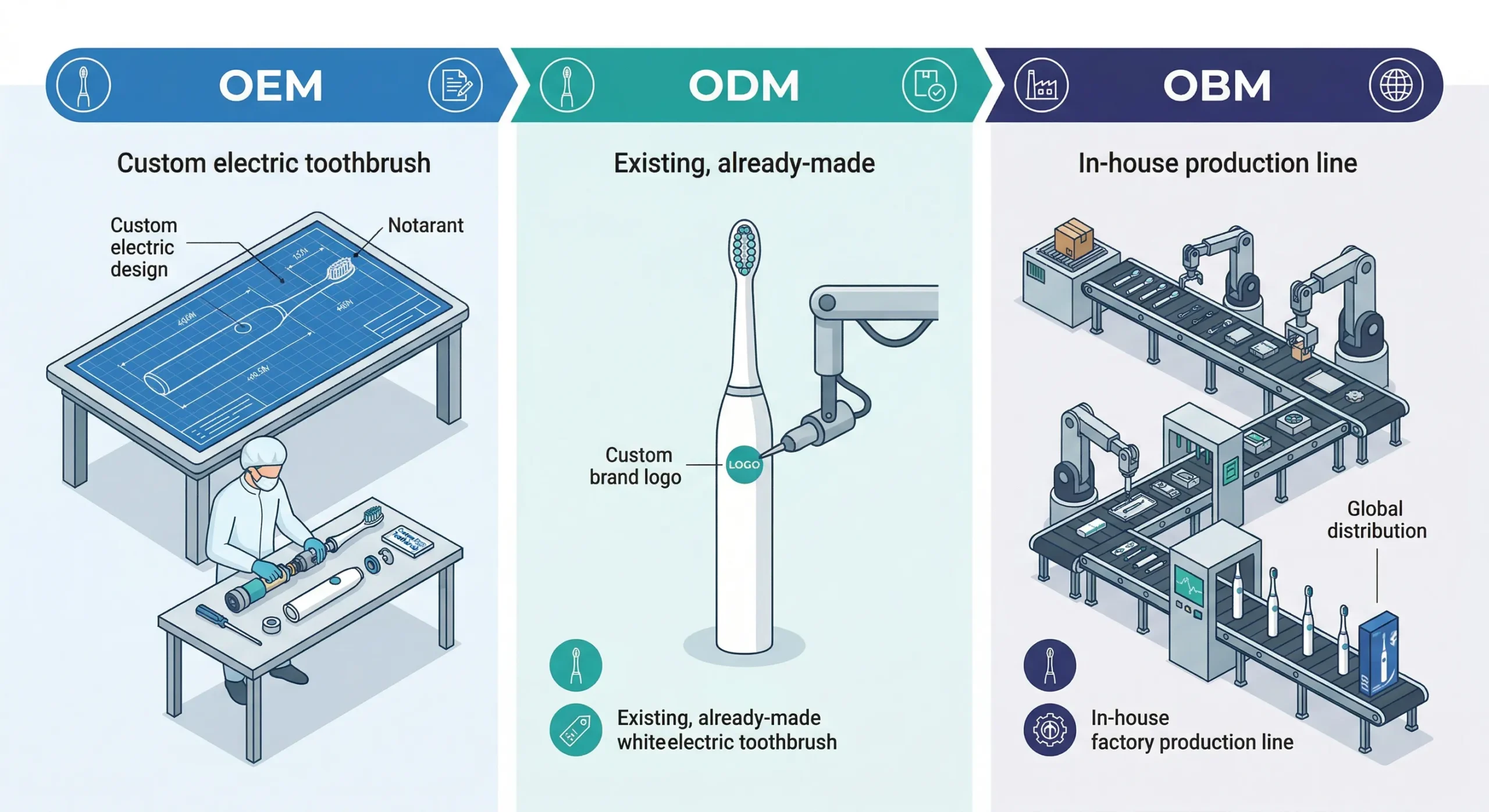
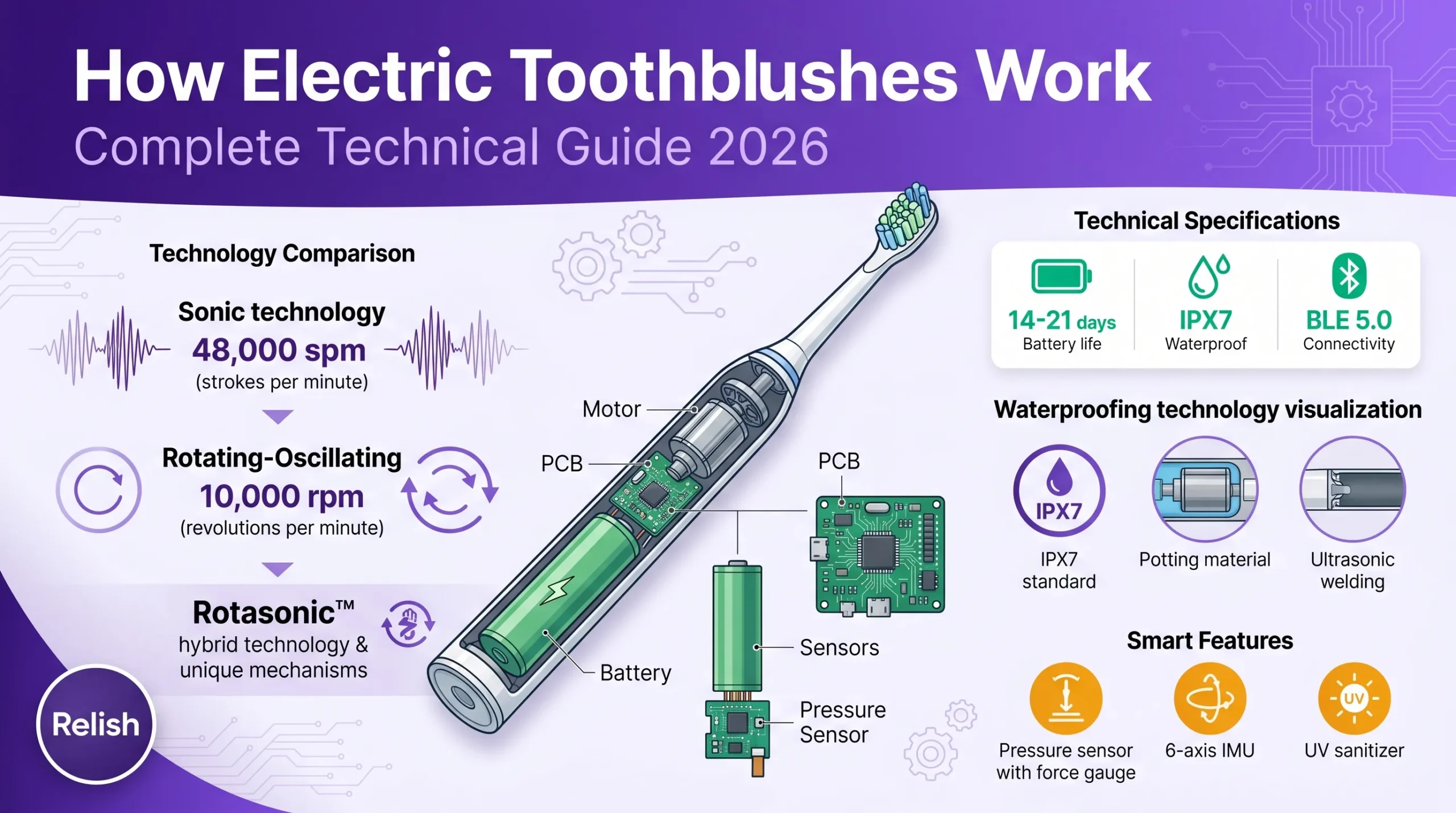
Before diving into individual components, it's important to understand that all electric toothbrushes fall into one of three fundamental technology categories. The category determines almost everything about how electric toothbrushes work — cleaning mechanism, noise level, battery consumption, and manufacturing cost.
1. Sonic Technology: Magnetic Coil Vibration
Understanding how electric toothbrushes work with sonic technology starts with the magnetic coil driver. A sonic toothbrush uses a magnetic coil driver (also called a voice coil actuator or linear resonant actuator) to convert electrical energy directly into rapid linear motion. Unlike a traditional motor that produces rotational motion, the magnetic coil driver generates a purely linear back-and-forth vibration at high frequency.
Here's the physics: an electric current passes through a coil of wire wrapped around a magnetically permeable core. When alternating current is applied, the coil alternately attracts and repels a permanent magnet attached to the brush head, causing it to vibrate at the frequency of the alternating current. The frequency is controlled by the oscillator circuit on the PCB — typically 120–240Hz, which translates to 240–480 brush strokes per second (or 24,000–48,000 strokes per minute).
The key innovation of sonic technology is fluid dynamic cleaning. At 30,000+ strokes per minute, the bristles and the toothpaste-saliva mixture create turbulent flow and acoustic micro-streaming. This hydrodynamic force extends the cleaning effect beyond the physical bristle contact, reaching 1–3mm beyond the bristle tips into the sulcus (gum pocket) and interproximal spaces. This is clinically significant: studies published in the Zeitschrift für klinische Parodontologie have shown sonic toothbrushes reduce gingivitis and plaque at distances up to 4mm from the bristle tip.
Relish Technology's proprietary Vibrosonic™ platform pushes this further with a dual-harmonic driver system. Where standard sonic brushes produce a single-frequency vibration, Vibrosonic™ adds a controlled secondary harmonic layer that creates a micro-pulsation effect. This does two things: it increases the effective cleaning radius of the fluid dynamics, and it creates a pressure wave that helps dislodge biofilm (plaque) from tooth surfaces without requiring the user to apply excessive physical pressure.
2. Rotating-Oscillating Technology: DC Gear Motor
Understanding how electric toothbrushes work with rotating-oscillating technology requires knowing the DC gear motor mechanism. Rotating-oscillating toothbrushes use a small DC (direct current) gear motor to rotate a circular or triangular brush head. The motor shaft is connected to a gear train that reduces rotational speed while increasing torque, then converts the rotational motion to an oscillating (back-and-forth) motion through a crank mechanism or Scotch Yoke linkage.
Typical rotating-oscillating heads complete 5,000–10,000 revolutions per minute, with oscillation arcs of 45–90 degrees. The Oral-B franchise is the canonical example: their patented oscillating-rotating technology was first introduced in the 1990s and has been continuously refined. The cleaning mechanism here is primarily direct bristle contact — the rotating bristles physically scrub tooth surfaces, with the oscillating motion helping to dislodge debris from the sulcus.
From a manufacturing standpoint, rotating-oscillating motors are generally less expensive than magnetic coil drivers, which makes this technology more common in the mid-range OEM market. The tradeoff is that the gear train adds mechanical complexity and potential points of failure, while the cleaning action is more dependent on bristle contact and less on fluid dynamics.
3. Combination / Rotasonic Technology
Understanding how electric toothbrushes work with combination technology reveals the Rotasonic™ approach. The third category is the combination or hybrid approach — devices that use both sonic vibration and rotating-oscillating action simultaneously. This is where Rotasonic™ technology, developed at Relish Technology, sits.
A Rotasonic™ toothbrush combines a magnetic coil driver (for the sonic component) with a micro DC motor driving an oscillating brush head. The result is dual-action cleaning: fluid dynamics from the sonic vibration plus direct mechanical scrubbing from the rotating-oscillating head. This combination is clinically shown to outperform either technology alone in plaque removal studies, particularly for users with orthodontic appliances or deeper gingival pockets.
The Anatomy of an Electric Toothbrush
Beyond the core cleaning technology, every electric toothbrush contains a system of interconnected components that work together to deliver a reliable, safe, and user-friendly brushing experience. Understanding how electric toothbrushes work at the component level helps OEM buyers evaluate quality and cost trade-offs during product development. Here's a component-by-component breakdown.
Rechargeable Battery
Lithium-ion (Li-ion) or NiMH. Li-ion offers 3× the energy density, no memory effect, and 500+ charge cycles. Capacity: 600–2,000mAh. Located in the handle body.
Motor & Driver Circuit
Magnetic coil (sonic) or DC gear motor (rotary). Driven by an H-bridge MOSFET circuit controlled by the microcontroller. Determines brushing frequency and torque.
PCB & Microcontroller
8–32 bit MCU manages brushing modes, timer, pressure sensor input, LED indicators, and BLE communication in smart models.
Pressure Sensor
Piezoresistive or capacitive force sensor between brush head and drive shaft. Triggers at 150–200g force. Sends signal to MCU to reduce power or activate warning.
Charging System
Inductive (Qi wireless) charging base or USB-C port. Charging coil in handle receives AC from base via electromagnetic induction. Charging time: 12–24 hours (inductive) or 1–3 hours (USB-C).
Brush Head & Drive Shaft
Replaceable head with nylon or PBT bristles. Connected to motor via stainless steel or nylon drive shaft. Click-fit or twist-lock attachment mechanism.
The PCB and Control System
The Printed Circuit Board (PCB) is the brain of the electric toothbrush. How electric toothbrushes work in terms of user experience — the variety of brushing modes, the 2-minute timer, the quadrant pacer — is all managed by the PCB firmware. In a typical OEM model, the PCB measures 20–50mm × 10–25mm and contains:
- Microcontroller Unit (MCU): An 8-bit to 32-bit processor (common choices: STM8, STM32, or budget MCUs from Sonix/Mesonix) running the firmware that manages all toothbrush functions
- Motor Driver: An H-bridge MOSFET circuit that translates MCU signals into the bidirectional current needed to drive the magnetic coil or DC motor
- Oscillator Crystal: Provides the precise clock signal that determines brushing frequency. A 32.768kHz crystal is common for RTC functions; a separate 8MHz crystal often drives the main CPU
- Pressure Sensor Interface: An analog-to-digital converter (ADC) channel that reads the voltage change from the pressure sensor
- LED Driver: Current-limiting resistor + transistor circuit controlling the mode indicator LEDs
- BLE SoC (smart models only): A Bluetooth Low Energy system-on-chip (Nordic nRF52832 or similar) that handles wireless communication with the companion app
- Charging Controller: A dedicated IC managing the charging process, over-charge protection, and charge level indication
Brushing Modes and the Quadrant Timer
One of the most valuable features of modern electric toothbrushes — from both a consumer and OEM design perspective — is the brushing mode system. How electric toothbrushes work with multiple modes depends on firmware-controlled frequency and amplitude profiles managed by the microcontroller. Each mode has a different frequency, amplitude, and timing profile, giving users flexibility for different oral care needs.
Common Brushing Modes
| Modus | Frequency | Amplitude | Dauer | Am besten für |
|---|---|---|---|---|
| Sauber | Full frequency (e.g., 40,000 spm) | Standard | 2 min | Daily use, all-around cleaning |
| White / Polish | Full + intermittent pulse | Höher | 2 min | Surface stain removal, coffee/tea drinkers |
| Empfindlich | 60–70% of max frequency | Reduced | 2 min | Receding gums, sensitive teeth, new users |
| Gum Care / Soft | 40–50% of max, pulsing | Low | 3 min | Gum health, periodontal maintenance |
| Tongue Clean | Low frequency, steady | Light | 30 sec | Breath freshening, tongue coating |
| Whitening | Alternating high/low | Variable | 3 min | Enhanced stain removal cycles |
Die quadrant timer (also called a 30-second pacer) is a critical compliance feature in how electric toothbrushes work for daily oral care. The toothbrush vibrates or pauses briefly every 30 seconds to signal the user to move to the next quadrant of their mouth (upper right, upper left, lower right, lower left). Clinical studies consistently show that quadrant timers increase average brushing duration by 30–45 seconds and significantly improve cleaning coverage.
Battery Technology and Charging Systems
The battery is the heaviest single component in an electric toothbrush handle, and its choice has cascading effects on product weight, runtime, charging behavior, and manufacturing cost. How electric toothbrushes work over the long term — in terms of daily usability and product longevity — is largely determined by battery choice. OEMs must balance these factors carefully against the target retail price point.
Lithium-Ion (Li-ion) vs Nickel-Metal Hydride (NiMH)
How electric toothbrushes work with Li-ion batteries distinguishes premium models from budget options. Li-ion batteries dominate modern premium electric toothbrushes. A typical 3.7V Li-ion cell (直径14mm × 高度43mm, known as 14450 form factor) provides 600–900mAh in a compact cylindrical package. The Sony/Murata INR14500 cells commonly used in electric toothbrushes offer:
- High energy density: 150–200 Wh/kg vs NiMH's 60–100 Wh/kg
- Low self-discharge: 2–3% per month vs NiMH's 20–30% per month
- No memory effect: Can be charged at any state of discharge
- 500+ cycle life: At 2 cycles/day, that's 250+ days of battery life — 2–3 years
- Faster charging: Full charge in 1–3 hours with modern USB-C or fast inductive chargers
NiMH batteries remain common in budget OEM models due to lower cost and simpler charging circuitry (no protection circuit required), but they are heavier, have shorter runtime, and suffer from gradual capacity loss due to the memory effect.
Charging Systems: Inductive vs USB-C
How electric toothbrushes work with different charging systems reflects fundamental OEM design trade-offs. Traditional inductive (wireless) charging uses electromagnetic induction between a coil in the charging base and a coil in the toothbrush handle. The handle coil receives AC current and converts it back to DC to charge the battery. Inductive charging is elegant (no exposed connectors = better water resistance) but inefficient (60–70% energy transfer) and slow (12–24 hours for full charge).
USB-C charging, increasingly common in newer models, offers direct electrical connection with 5V/1A–3A input. This enables fast charging (0–100% in 1–3 hours) and eliminates the bulky charging base. Understanding how electric toothbrushes work with USB-C charging reveals another OEM design trade-off: USB-C requires a waterproof gasket around the connector port but simplifies the handle interior (no charging coil needed), which can offset cost.
Water Resistance: IPX7 and the Engineering Challenge
Electric toothbrushes are used in wet environments and must withstand immersion. How electric toothbrushes work reliably in wet environments depends on achieving the IPX7 rating (Ingress Protection), which means the device can be submerged in water up to 1 meter depth for 30 minutes without water ingress. Achieving IPX7 with electronic components inside requires careful engineering:
Potting and Ultrasonic Welding
How electric toothbrushes work reliably in wet environments comes down to waterproofing engineering. The primary waterproofing technique is potting: filling the interior of the electronics compartment with a thermoset resin (commonly epoxy or silicone-based). Potting protects the PCB, motor, and battery connections from moisture but makes the electronics unrepairable and adds manufacturing cost ($0.80–$2.50 per unit in material + labor).
An alternative or complementary technique is ultrasonic welding of the plastic housing halves. Understanding how electric toothbrushes work with sealed waterproofing requires knowing this technique: the two halves of the handle are welded together using high-frequency vibration (typically 20–40kHz), creating a continuous, seamless bond that is structurally stronger than the surrounding plastic and provides a reliable seal against water ingress at the housing seam.
For the brush head attachment area — the most mechanically stressed seal point — silicone O-rings or liquid gasket sealant are used. The drive shaft passes through this seal via a close-tolerance bushing, maintaining waterproofing while allowing rotational or linear motion.
Need Help Specifying Your Electric Toothbrush?
Curious how an electric toothbrush works for your brand? Our engineers can walk you through motor selection, waterproofing strategy, and BOM cost optimization for your target market.
Talk to Our Engineering TeamSmart Toothbrushes: Sensors, BLE, and App Connectivity
Smart toothbrushes add a layer of digital intelligence on top of the core brushing mechanism. The underlying motor, battery, and brush head are identical to non-smart models — what changes is the addition of a Bluetooth Low Energy (BLE) system-on-chip, additional sensors, and companion app software. Understanding how electric toothbrushes work with smart features requires knowing both the physical brushing mechanism and the data layer built on top of it.
Key Smart Features and Their Sensors
| Intelligente Funktion | Sensor Used | Technical Detail |
|---|---|---|
| Brushing Duration | Real-time clock (MCU timer) | Built into MCU — no additional sensor needed |
| Pressure Detection | Piezoresistive or capacitive force sensor | Located between brush head and drive shaft mount |
| Position Detection | 6-axis IMU (accelerometer + gyroscope) | Detects brush movement direction and quadrant coverage |
| Brush Head Wear | Bristle impedance sensor | Measures bristle wear via electrical resistance change |
| Battery Health | Fuel gauge IC (coulomb counter) | Tracks charge cycles and remaining capacity |
| Bluetooth Pairing | BLE 4.0–5.0 SoC | Nordic nRF52 series most common in oral care |
The 6-axis Inertial Measurement Unit (IMU) — combining a 3-axis accelerometer and 3-axis gyroscope — is the most technically sophisticated sensor in a smart electric toothbrush. Understanding how electric toothbrushes work with position tracking requires knowing the IMU: by analyzing the pattern and direction of brush head movement, the IMU enables quadrant mapping. The app can determine which region of the mouth the user is brushing and provide zone-by-zone feedback. Combined with brushing duration data, this gives a complete picture of brushing coverage. In summary, how electric toothbrushes work with smart features adds data-driven feedback but the core cleaning mechanism remains the same as non-smart models.
The OEM Perspective on Smart Toothbrush Costs
Adding smart features changes how electric toothbrushes work from a purely mechanical to a mechatronic device. Smart toothbrush BOM costs increase approximately $8–$25 per unit, depending on feature complexity. The largest cost drivers are:
- BLE SoC + antenna: $2.50–$5.00 (Nordic nRF52840 is the premium choice; Realtek RTL8762 is the budget option)
- 6-axis IMU: $1.50–$4.00 (TDK InvenSense ICM-42670 or BMI270 are common choices)
- Drucksensor: $0.30–$1.00 (premium piezoresistive vs basic capacitive)
- App development: $30,000–$150,000 one-time cost for iOS + Android (the biggest variable)
- Additional PCB layers and components: $1.00–$3.00
The retail price premium for smart features is typically $25–$60, making smart technology highly profitable for brands that can manage app development and maintenance costs.
UV Sanitizing Technology
UV sanitizing stations have become a premium feature in high-end electric toothbrushes. How electric toothbrushes work with UV sanitizing technology depends on a separate germicidal light system integrated into the charging base. The technology uses UV-C light at 254nm wavelength, which is strongly absorbed by microbial DNA and RNA. UV-C radiation causes thymine dimers in bacterial and viral DNA, preventing replication and effectively killing 99.9%+ of microorganisms on the brush bristles within a 5–10 minute sanitizing cycle.
The UV-C lamp in a toothbrush sanitizer is typically a low-pressure mercury lamp (similar to those in water purification systems) or a UV-LED. Mercury lamps are more effective but contain a small amount of mercury (0.5–2mg) and are fragile. UV-LEDs are more durable and environmentally friendly but produce less UV-C intensity and have a shorter effective lifespan (typically 8,000–10,000 hours). Understanding how electric toothbrushes work with UV sanitizers from an OEM perspective helps buyers evaluate the trade-off between germicidal effectiveness and product durability.
From an OEM standpoint, integrating a UV sanitizer into the charging base adds approximately $3.50–$8.00 to the BOM and requires a larger charging base housing (affecting retail packaging dimensions). The benefit: it creates a compelling premium feature and justifies a higher price tier.
Brush Heads: Bristle Science and Engineering
While the handle contains all the electronic intelligence, the brush head is where the cleaning actually happens. Understanding how electric toothbrushes work to deliver effective oral care requires knowing brush head engineering — bristle material, diameter, tuft configuration, and flexural properties all influence cleaning performance and user experience.
Bristle Materials
How electric toothbrushes work to deliver effective plaque removal depends significantly on bristle engineering. Nylon (Nylon 612) is the most common bristle material, with Tynex bristles (DuPont's brand) setting the industry standard for consistency and durability. Typical diameter: 0.15–0.25mm for cleaning filaments, 0.30–0.50mm for outer cleaning border. PBT (Polybutylene Terephthalate) is softer than nylon, used in sensitive or gum-care brush heads with better shape memory. End-rounded bristle tips (R ≤ 0.01mm radius) are critical for gum health — verified via microscopy inspection in OEM quality control.
Indicator Bristles
How electric toothbrushes work with user-facing hygiene feedback features includes the indicator bristle system. Blue indicator bristles (also called "color fading bristles") are a common OEM feature that signals when brush head replacement is needed. These bristles use a fade dye that degrades when exposed to toothpaste abrasives and mechanical stress. After approximately 3 months of normal use, the blue color fades to white, signaling the user to replace the brush head. From an OEM perspective, indicator bristles add $0.05–$0.15 per head and require a dual-material injection molding process to create two-tone tufts.
OEM Manufacturing: From Component Selection to Mass Production
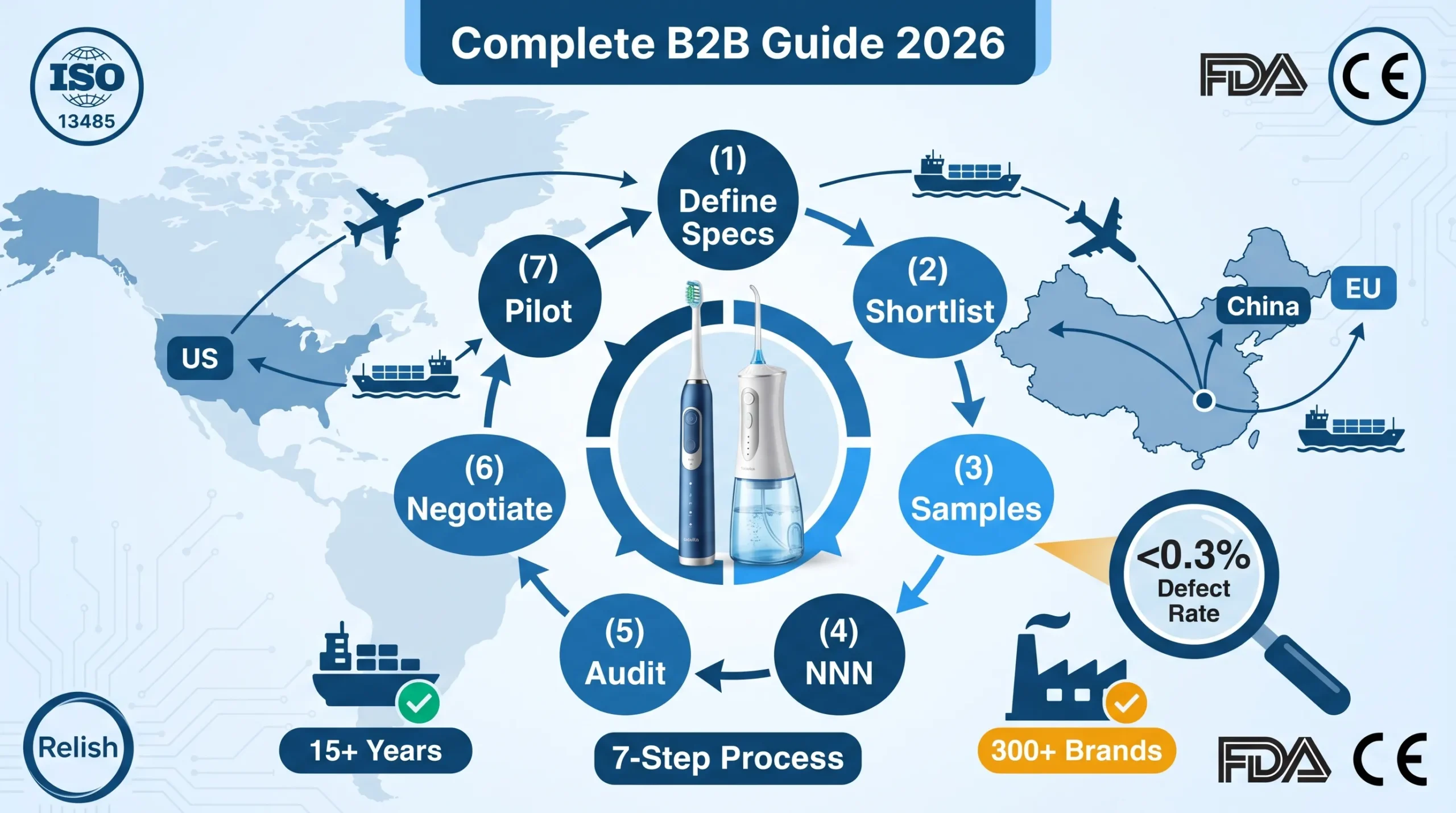
Understanding how electric toothbrushes work from a manufacturing perspective is the foundation for making intelligent OEM sourcing decisions. Every technical choice — motor type, battery capacity, waterproofing method, smart sensor integration — has a direct, quantifiable impact on manufacturing cost, product quality, and retail positioning. Read our electric toothbrush OEM guide for a deeper dive into the manufacturing pathway.
At Relish Technology, understanding how electric toothbrushes work across the full technology stack — from motor physics to app connectivity — informs every step of the development process:
- Concept validation (weeks 1–4): Define product specification — technology type (sonic/rotary/Rotasonic), target markets, required certifications, price tier. This drives all subsequent decisions.
- Prototype development (weeks 5–12): Build functional prototypes of handle, electronics, and brush head. Test motor performance, battery runtime, waterproofing, and PCB firmware. Typical prototype quantity: 3–10 units.
- Pre-production validation (weeks 13–20): Engineering validation testing (EVT) and design validation testing (DVT) — IPX7 immersion testing, drop testing, EMC testing, battery cycle testing, and regulatory pre-compliance testing.
- Mass production preparation (weeks 21–28): Tooling completion, first article inspection, pilot run (100–300 units), and quality system setup including AQL sampling plans.
- Production and shipment: Full production runs with continuous quality monitoring. How electric toothbrushes work reliably at scale depends on rigorous AQL sampling and production line quality control. Relish Tech's production lines operate at AQL 0.65 for critical defects, 1.0 for major defects. Besichtigen Sie unsere Produktionsstätten to see our production capabilities firsthand.
How to Choose the Right Technology for Your Brand
With the technical foundation established, here is a decision framework for brand owners and procurement managers selecting an OEM partner for electric toothbrush development. Understanding how electric toothbrushes work across all three technology categories — sonic, rotating-oscillating, and Rotasonic™ — enables more informed conversations with manufacturers and more accurate product specifications.
| Kriterien | Sonic | Rotating-Oscillating | Rotasonic™ (Combination) |
|---|---|---|---|
| BOM Cost Range | $12-$28 | $8-$20 | $18–$38 |
| Retail Price Positioning | Mid to Premium | Entry to Mid | Premium to Ultra-Premium |
| Noise Level | Medium (whine sound) | Low to Medium (hum) | Mittel-Hoch |
| Cleaning Depth | High (fluid dynamics) | Medium (bristle contact) | Highest (dual action) |
| Best Market Fit | Premium consumer brands | Value brands, Amazon FBA | Clinical/dental professional brands |
| Smart Feature Suitability | Excellent | Good | Excellent |
Sind Sie bereit, Ihr OEM-Projekt für elektrische Zahnbürsten zu starten?
Whether you're launching a new brand, expanding an existing line, or sourcing for retail procurement — Relish Technology's engineering team can help you select the right technology platform and navigate the full journey from concept to mass production.
Talk to Our Engineering TeamISO 13485 · FDA/CE/ISO13485 Certified · 15+ Years OEM Experience · 20,000㎡ Manufacturing Facility
Häufig gestellte Fragen
This FAQ section answers the most common questions about how electric toothbrushes work — from basic mechanisms and technology differences to smart features and OEM manufacturing considerations for buyers sourcing from China. Whether you're evaluating brushing modes, battery performance, or waterproofing standards, these answers will help you understand how electric toothbrushes work at every level.
Referenzen und Quellen
- Hope, C.K. et al. (2023). The Clinical Efficacy of Sonic Toothbrushes: A Systematic Review. Zeitschrift für klinische Parodontologie. Abgerufen von https://onlinelibrary.wiley.com/doi/10.1111/jcpe.13842
- International Electrotechnical Commission. (2012). IEC 60601-1:2005+AMD1:2012 — Medical Electrical Equipment Part 1: General Requirements for Basic Safety and Essential Performance. Abgerufen von https://www.iso.org/standard/72744.html
- International Organization for Standardization. (2023). ISO 20749:2023 — Dentistry — Powered toothbrushes — Test methods for measuring the performance of powered toothbrushes for oral health care. Abgerufen von https://www.iso.org/standard/83130.html
- U.S. Food and Drug Administration. (2025). Premarket Notification 510(k) Substantial Equivalence Determinations — Electric Toothbrushes. Abgerufen von https://www.fda.gov/medical-devices/products-and-medical-procedures/powered-toothbrushes
- Nordic Semiconductor. nRF52840 Product Specification v1.1 — Multiprotocol Bluetooth 5/BLE SoC datasheet. Retrieved from https://docs.nordicsemi.com/bundle/nRF52840_PS
- TDK Invensense. BMI270 — 6-Axis Inertial Measurement Unit datasheet and application notes. Retrieved from https://invensense.tdk.com/products/motion-tracking/6-axis/bmi270/