










Amazon Compliance for Electric Toothbrushes: U.S. Requirements Guide
A practical guide to the U.S. rules that may apply to electric toothbrushes and to the product records Amazon may request. Learn how to assess FDA, FCC, electrical-safety and California Proposition 65 requirements for your specific product and listing.
Auf einen Blick
- Powered toothbrushes are generally Class I devices under FDA product code JEQ; many are 510(k)-exempt, subject to the intended use and exemption limits.
- FCC requirements depend on the product’s circuits, radio functions, accessories and any applicable exemptions.
- Amazon documentation requests vary by product, ASIN, marketplace and seller account. Check the current request in Seller Central.
- Proposition 65 warnings depend on exposure to listed chemicals and applicable exemptions or safe-harbor levels; a material’s presence alone does not decide the warning duty.
- Seller account documentation should match the current request; gather the product specifications, supplier records and applicable test evidence before sourcing.
- Assign responsibility for the product records, U.S. regulatory requirements and Amazon submissions before placing an OEM order.
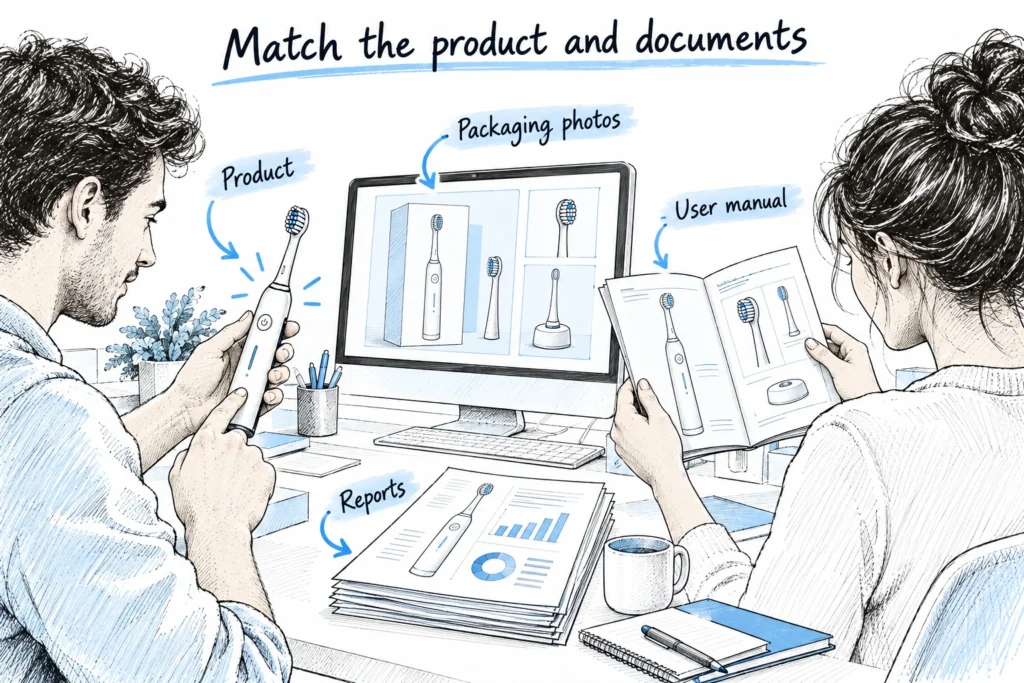
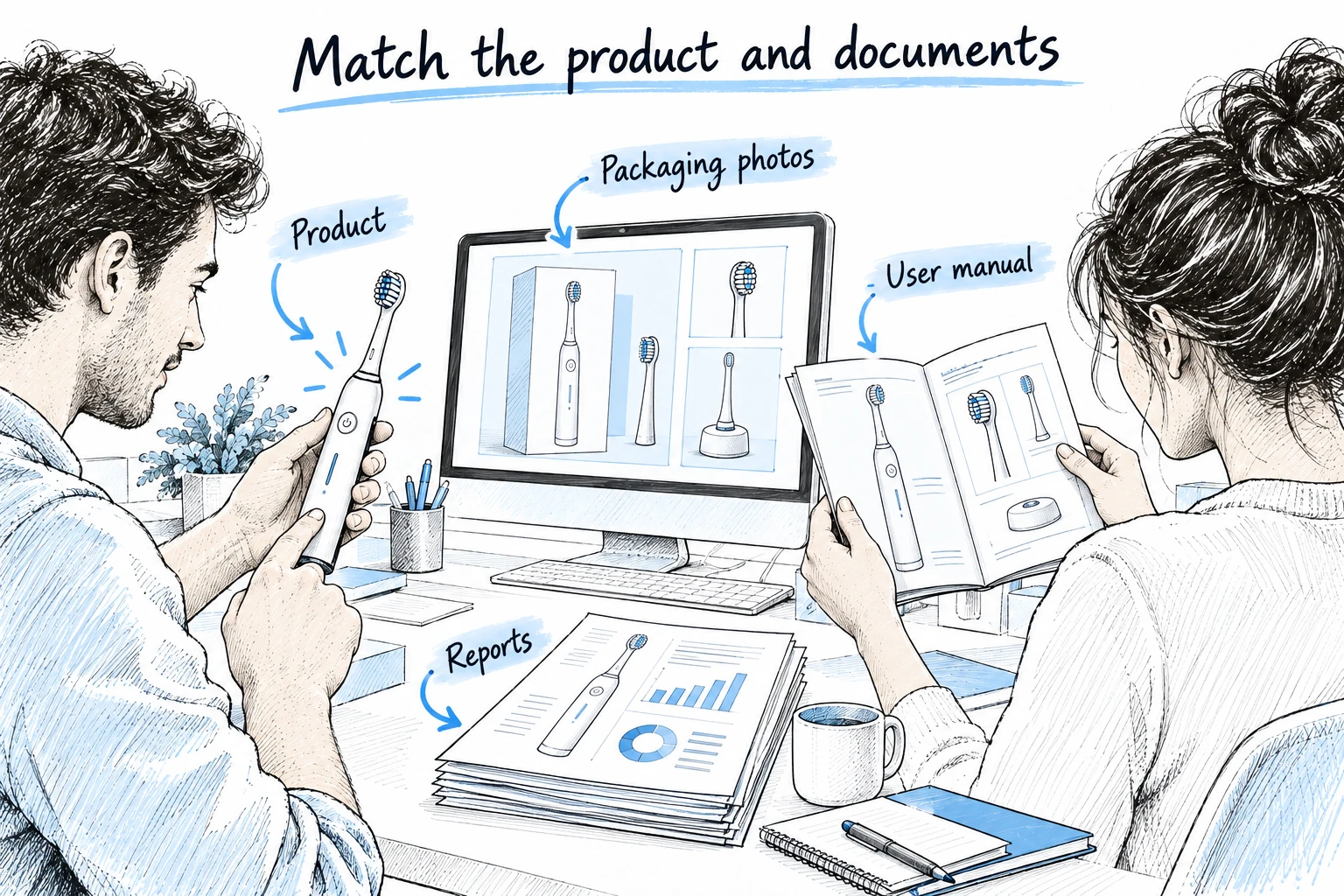
When Amazon sends an ASIN request, match each requested document to the exact model and configuration, check the report scope, and note the submission deadline before responding.
A listing issue can interrupt sales, so identify the actual request, applicable rule and response deadline before taking action. FDA, FCC, electrical-safety, California chemical-warning and marketplace requirements have different scopes.
Why Product-Specific Compliance Matters on Amazon
Amazon’s seller policies und legal requirements are separate. Sellers are responsible for the laws that apply to their product and for responding to any documentation request on the listing or account. A marketplace request does not by itself establish that a particular FDA clearance or third-party certificate is legally required.
Where Requirements May Be Checked
The parties involved depend on the product and the specific issue. Common checks include:
- U.S. Customs and Border Protection may review imported goods and request records under the rules that apply to the shipment; FDA 510(k) paperwork is not a universal entry requirement for every powered toothbrush.
- FDA classification and records: Check the device’s product classification, intended use and claims. Confirm which establishment registration, device listing and premarket-notification duties apply to your role and the specific device; registration and listing are not FDA approval.
- Amazon may request documents for a particular ASIN, product category, marketplace or account. Follow the exact current request and its stated response deadline.
- Safety complaints: Set up a process to receive complaints, record the model and lot, assess the issue, and escalate reports when required by applicable FDA rules or marketplace procedures.
FDA Classification and Premarket Requirements
FDA lists powered toothbrushes under product code JEQ and regulation 21 CFR 872.6865 as Class I devices. Many powered toothbrushes are exempt from 510(k) premarket notification, subject to the limitations in 21 CFR 872.9 and the product’s intended use and technology. Review the exact device before deciding whether a submission is required.
FDA Registration, Device Listing and 510(k) Are Different
Establishment registration and device listing, quality-system obligations, and premarket notification are separate FDA requirements. Whether each applies depends on the establishment’s role and the device. FDA’s Quality Management System Regulation (QMSR) took effect on 2 February 2026 and incorporates ISO 13485:2016 by reference with additional requirements; a voluntary ISO certificate does not replace the applicable FDA obligations.
| Anforderung | Establishment registration and device listing | 510(k) premarket notification |
|---|---|---|
| Was es ist | Registration and listing record information about covered establishments and devices; neither constitutes FDA approval. | A premarket submission demonstrating substantial equivalence when the device is subject to 510(k) and no exemption applies. |
| Rechtsgrundlage | 21 CFR Part 807, where applicable | 21 CFR Part 807, Subpart E, where applicable |
| Wer archiviert | Each establishment that has a registration duty; a foreign establishment designates a U.S. agent where required. | The 510(k) submitter for a device subject to premarket notification; the responsible party depends on the device and arrangement. |
| Zeitplan | Follow the current FDA registration and listing process and annual renewal requirements. | Only if a 510(k) is required; review timing depends on the submission and FDA process. |
| Kosten | Use FDA’s current annual registration-fee schedule; consulting or agent fees are separate. | Project-specific; confirm current testing and submission costs with the relevant providers. |
| Amazon request | May be requested for a specific establishment or product; verify the current ASIN/account request. | Only if applicable to the device or specifically requested; an exemption must be assessed rather than assumed. |
| Was damit nachgewiesen wird | Registration or listing does not mean FDA has approved or cleared the product. | A clearance applies to the device and indications in the specific decision; it does not cover unrelated models. |
Braucht jede elektrische Zahnbürste eine 510(k)-Zulassung?
No. Many powered toothbrushes are listed by FDA under product code JEQ as Class I and are 510(k)-exempt, subject to the limits in 21 CFR 872.9. Before listing, check the device’s intended use, claims, technology and exact configuration against current FDA classification information. For EU requirements, see our CE marking guide for electric toothbrushes.
If a device is subject to 510(k), the submitter must follow the applicable FDA requirements and support the intended use and substantial-equivalence determination. A similar product name or competitor listing does not establish a valid predicate or permit use of another company’s data.
- Check the product code and applicable exemption limits.
- Confirm the intended use, labeling and claims for the model.
- Identify whether a proposed predicate and its data can legally support the submission, if one is required.
For the exact model, gather its description, specifications, materials, indications, test reports and labeling. Ask the OEM who holds each record and whether the planned intended use or technology requires an FDA submission; confirm that the evidence covers the brand and configuration you plan to market.
FCC Equipment Authorization and Compliance
FCC rules may apply to unintentional or intentional radio-frequency emissions, depending on the product’s circuits, functions, accessories and exemptions. A battery-powered toothbrush is not automatically subject to a single authorization route; assess the finished configuration.
FCC Part 15: Unintentional vs. Intentional Radiators
FCC Part 15 distinguishes unintentional radiators, such as digital circuitry that generates RF internally, from intentional radiators designed to transmit RF, such as Bluetooth radios. Incidental radiators, including some motor-driven devices, are a separate category under 47 CFR 15.3. Confirm the equipment type and authorization route for the finished configuration.
| Device type | Possible FCC route | Scope to assess | Zeitplan | Kosten |
|---|---|---|---|---|
| Toothbrush without intentional radio transmission | Assess Part 15B scope and exemptions; use the applicable compliance procedure. | Relevant emissions and equipment requirements for the final configuration. | Project-specific; confirm with the testing provider. | Project-specific; request a current quote. |
| Toothbrush with Bluetooth or another intentional transmitter | Radio-frequency equipment authorization may require certification; confirm the applicable rule and integration conditions. | Identify the transmitter, antenna, host integration and applicable FCC rule for the technology. | Depends on testing, review scope and any integration conditions. | Project-specific; request a current quote. |
Supplier’s Declaration of Conformity and certification are different procedures. For SDoC, the responsible party must be located in the United States; testing and recordkeeping must follow the applicable rule, but an accredited laboratory is not universally required. Where certification is required, an FCC-recognized Telecommunication Certification Body (TCB) evaluates the application. Inductive charging alone does not establish that a product intentionally transmits radio communications. See our oral-care sourcing guide for broader supplier-planning information.
Electrical-Safety Evidence
For an electric toothbrush, assess IEC/UL 60335-1 together with product-specific IEC/UL 60335-2-52 for oral-hygiene appliances when applicable. Confirm the edition, certification scope and requested evidence with the testing laboratory and marketplace. Use IEC 60601 only when the product and applicable rules call for medical-electrical-equipment requirements.
NRTL Certification Marks and Test Reports
UL, ETL and CSA marks are issued under certification programs whose scope must cover the specific product and applicable standard. OSHA recognizes NRTLs for specified test standards and products; this does not make every report or mark interchangeable for every Amazon listing. Check the relevant law, buyer or marketplace request.
- UL Listed: This mark applies to the product and certification scope shown in the UL listing.
- ETL Listed: This mark applies to the product and certification scope shown in Intertek’s listing.
- CSA Listed: This mark applies to the product and certification scope shown in the CSA certification record.
| Test component | Applicable standard or method | What the assessment addresses | Example of a finding |
|---|---|---|---|
| Dielectric withstand | UL 60335-1 clause and edition applicable to the finished product; confirm the test method with the laboratory. | Insulation and electrical separation. | Insulation breakdown or flashover at the voltage and under the conditions specified by the applicable test method. |
| Leakage current | Leakage-current requirements in the applicable standard, edition and test condition. | Current under the conditions specified by the applicable method. | Measured current exceeds the limit specified by the applicable test method for that product and condition. |
| Water ingress | IEC 60529 or other applicable product test method. | Protection against water ingress for the rated configuration. | Water reaches a component that the product’s rating requires to remain protected. |
| Drop or impact | UL 60335-1 and the applicable product-specific standard, edition and impact/drop sequence. | Safety after the specified impact or drop sequence. | Examples include battery displacement or accessible live parts after the specified drop or impact sequence. |
| Battery safety | Applicable cell or battery standard and transport requirements, as relevant. | Cell/battery safety and transport evidence; these are separate from whole-product CE or FCC assessments. | Examples include abnormal battery temperature rise, swelling, leakage or other visible damage during applicable battery tests. Use the relevant cell/battery method and criteria. |
Kalifornien Proposition 65
Assess the actual product materials and consumer exposure. Where OEHHA has established a safe-harbor level for the listed chemical and exposure route, compare exposure with that level. If no level applies, assess whether Proposition 65 requires a warning and whether a specific exemption applies. A substance’s presence in a component alone does not determine the outcome.
Assess actual materials, contact routes, foreseeable use and exposure before drawing a conclusion. Potential sources may include:
- Lithium-Ionen-Batterien: Identify the actual materials and whether a relevant listed chemical could result in consumer exposure.
- Plastic parts: Assess the specific material and use; do not assume a toothbrush contains BPA or that its presence alone triggers a warning.
- Circuit boards and solder: Review material information and potential exposure to any listed substances.
- Metal components: Identify the specific material or compound and exposure route; stainless steel or nickel content alone does not determine a warning duty.
Use a product-specific exposure assessment to identify listed chemicals, contact routes and foreseeable use. Where OEHHA has established a safe-harbor level, compare exposure with the applicable level; where no level is established, assess warning duties under Proposition 65 and any exemption whose criteria are met. Follow the current warning format when a warning is required.
Amazon Documentation Requests
Amazon requests vary by ASIN, product category, marketplace, account and current policy. Check the exact notice in Seller Central and submit only the evidence requested for that listing. Marketplace requirements are separate from the legal assessment.
Responding to a Request
When Amazon requests records for an ASIN, read the current Seller Central notice and match each requested document to the product model, configuration and marketplace. Check the report scope and response deadline before submitting.
- FDA records or clearance: Provide the records that apply to the device and the exact request; registration is not a substitute for a required 510(k).
- FCC evidence: Provide the applicable test or authorization records for the product’s radio functions and compliance route.
- Electrical-safety evidence: Provide product-specific reports or certification records when requested and ensure their scope matches the model.
- Product and packaging images: Provide current images if the notice requests them.
- Instructions and labeling: Provide the version that applies to the product and target market if requested.
- California warning information: Provide a product-specific assessment or warning information when applicable and requested.
Plan the evidence before responding to an Amazon request
Relish Tech can discuss the product configuration, available project records and responsibilities with an OEM/ODM customer. Any external testing, regulatory submission or marketplace decision depends on the specific product and the parties involved.
Project Documentation for OEM/ODM Products
Keep product records organized for marketplace and regulatory requests. Ask the project team which documents are available, which model and configuration each covers, and who will prepare, submit and maintain them.
- Model records: Confirm the model, configuration, intended use and record owner; request evidence for the version you plan to list.
- FCC coordination: Determine whether FCC rules apply and agree any testing or authorization work for the specific configuration.
- Material and exposure information: Gather supplier records needed to assess applicable chemical restrictions or warning obligations.
- Marketplace response: Compare available records with the current Amazon notice and the listed model before submission.
- U.S. agent: Check whether FDA establishment-registration rules require the foreign establishment to designate a U.S. agent, and confirm who will fill that role.
A manufacturer can help organize project information, but the brand owner, manufacturer, importer, agent and marketplace each have different responsibilities. Confirm those roles and the current evidence before a listing or shipment.
Grundlagen der OEM-Beschaffung
Standard custom MOQ: 1,000 units; smaller quantities may be discussed case by case.
Timing: Testing, documentation and manufacturing schedules depend on product scope and the project quotation.
Quality controls: Agree the inspection criteria, sampling plan and any AQL in the project specification or contract.
Product-specific FDA route · FCC equipment authorization · electrical-safety evidence · California exposure assessment
Planning Compliance for Your Electric Toothbrush
Share the product configuration, intended use, target market and any current Amazon request with the project team. We can discuss which records may be available for the agreed OEM/ODM project; regulatory and marketplace decisions remain with the responsible parties.
Compliance-Beratung anfordernHäufig gestellte Fragen
Use these answers to identify which records to check for your product, marketplace and seller account. Before submitting materials, confirm the current Amazon request and the applicable FDA, FCC and California requirements.
Quellen
- U.S. Food and Drug Administration. Product Classification: Powered toothbrush (JEQ; 21 CFR 872.6865). FDA Product Classification Database
- U.S. Food and Drug Administration. Quality Management System Regulation (QMSR). FDA QMSR
- Electronic Code of Federal Regulations. 47 CFR Part 15: Radio Frequency Devices. eCFR Part 15
- UL Standards & Engagement. UL 60335-2-52: Household and similar electrical appliances — Safety — Particular requirements for oral hygiene appliances. UL Standards
- California Office of Environmental Health Hazard Assessment. Proposition 65: Frequently Asked Questions. OEHHA Proposition 65 Help Desk
- Amazon Seller Forums. Compliance guidance for covered rechargeable lithium-ion household appliances. Amazon Seller Forums
- Internationale Elektrotechnische Kommission. IEC 62133-2: Secondary cells and batteries containing alkaline or other non-acid electrolytes. IEC Webstore