











Rotasonic Toothbrush: One Servo Motor, Every Cleaning Motion
A rotasonic toothbrush is Relish Tech’s flagship brushing platform, built around a single servo motor whose drive shaft can swing to any angle from 0 to 360° or rotate in a full circle. Because the shaft is not locked to one fixed arc, the same rotasonic head can sweep, oscillate, vibrate, whiten, and polish, putting several cleaning actions into one device. This guide explains how the system works and which products carry it.
- Rotasonic is a servo driven system with a shaft that swings any angle from 0 to 360° or rotates fully.
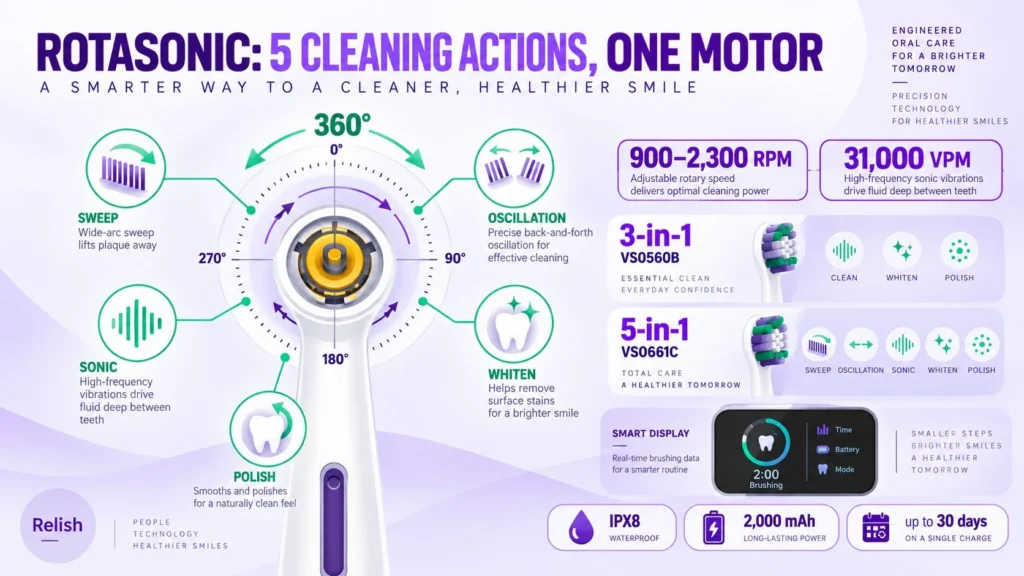
- One motor produces multiple actions: sweep, oscillation, sonic, whiten, and polish.
- The head rotates at 900 to 2,300 RPM on top of 31,000 VPM sonic vibration.
- It spans two platforms: the 3 in 1 VS0560B and the 5 in 1 VS0661C.
Want a rotasonic platform in your catalog? Explore private label options →
What Is a Rotasonic Toothbrush?
The name points at the core idea: rotation plus vibration, delivered by one servo motor. Most electric toothbrushes move the head through a fixed mechanical linkage, so the head does one thing and does it the same way every time. A rotasonic toothbrush replaces that fixed linkage with a servo driven shaft that can swing through any angle from 0 to 360°, or rotate in a complete circle. That freedom is what lets one brush stand in for several different cleaning tools.
In effect, the rotasonic system does not compete with one category of toothbrush. It folds the classic sonic vibration, a sweeping scrubbing motion, a wide oscillation, and a full polishing rotation into a single head, which is why Relish Tech positions it as an all in one oral cleaner rather than another single motion brush.
One Motor, Five Cleaning Actions
Because the servo shaft can move freely, the same rotasonic toothbrush can switch between distinct cleaning actions instead of a single fixed stroke.
What Each Cleaning Action Does
- Sonic. High frequency vibration at 31,000 VPM drives fluid and foam along the gum line for indirect cleaning.
- Sweep. A low frequency sweeping motion carries the bristles across the tooth surface for direct mechanical scrubbing.
- Oscillation. The head swings through a wide arc, giving the rotating reach of a classic oscillating brush.
- Whiten. A dedicated action targets surface staining for a brighter finish.
- Polish. A full 360° rotation drives a polish cup or brush to buff and shine the enamel.
The product pages list the rotational speed at 900 to 2,300 RPM, layered on top of the 31,000 VPM sonic frequency. That combination of true rotation plus high speed vibration is what sets the rotasonic head apart from both a plain sonic brush and a conventional oscillating brush.
Rotasonic vs. Vibrosonic and Sonic
The three terms line up as a technology progression. A first generation sonic brush vibrates in place and cleans through fluid. Vibrosonic stacks two motions, vibration plus a 60° oscillation. Rotasonic goes further, letting a servo shaft move through any angle or rotate fully, so the head can also sweep, whiten, and polish.
How the Three Motions Compare
Independent research frames the broader category. The American Dental Association (ADA) describes powered toothbrushes as an effective alternative to manual brushing, a conclusion echoed by the Cochrane review of manual versus powered brushing (Heanue et al., 2003). A narrative review of powered-toothbrush design adds that the rotational design has been advocated as clinically more effective than manual brushing. For the two motion step that sits between sonic and rotasonic, read our explainer on Vibrosonic technology.
The Rotasonic Product Range
Die rotasonic platform ships in two configurations, both with an LCD smart display, a 2,000 mAh battery for up to 30 days, and IPX8 waterproofing.
- VS0560B (3 in 1) combines sweep, oscillation, and sonic vibration with 5+1 cleaning modes, wireless plus USB-C charging, and a 900 to 2,300 RPM rotation speed.
- VS0661C (5 in 1) is the flagship, adding whiten and polish actions to the sweep, oscillation, and sonic base, with magnetic wall mounted charging alongside Type-C.
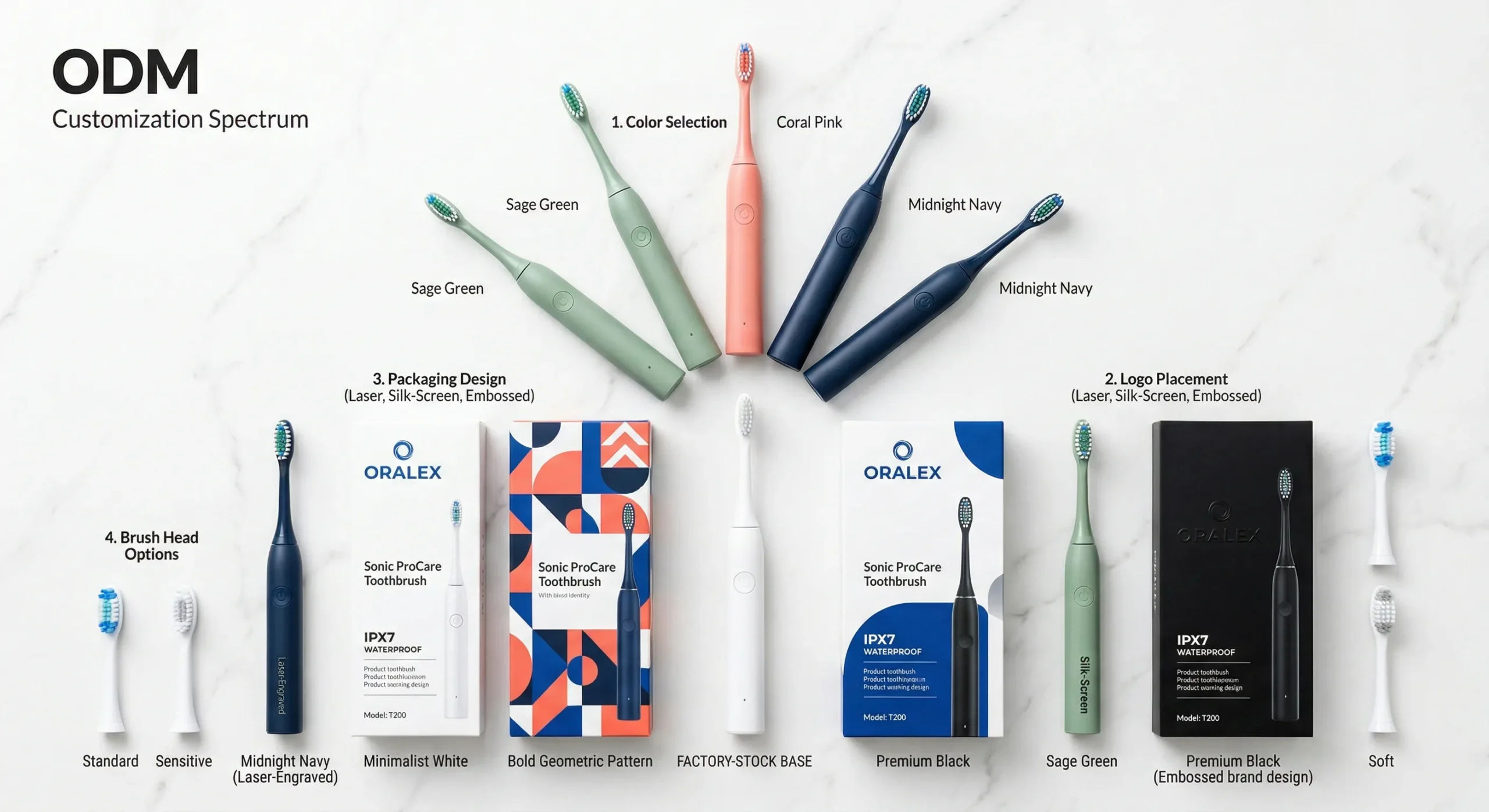
Both are OEM and private label platforms, so the same rotasonic toothbrush core can be configured with custom colors, brush heads, and packaging for a buyer’s brand.
What the Servo Shaft Changes
The practical value of the rotasonic design is flexibility. A conventional brush is sold on one motion, and the only differentiation left is color, head shape, or marketing. A servo driven shaft changes the calculus: a single handle can be configured to emphasize sweep, oscillation, whitening, or polishing depending on the market, the retail positioning, or the end user’s preference. That makes it a platform rather than a single fixed product, which is the core OEM argument behind it.
For Brands: The Rotasonic Platform
For OEM and private label buyers, the rotasonic toothbrush is the differentiated, flagship tier of the electric toothbrush range. It is the platform to lead with when a brand wants a premium, feature rich hero product rather than a commodity SKU.
Why Rotasonic Leads the Range
- Lead with the all in one story. “Five cleaning actions in one head” is a retail argument a single motion brush cannot match.
- Offer the 3 in 1 and 5 in 1 tiers. The VS0560B and VS0661C give a brand an entry and a flagship within the same platform.
- Use the LCD as a differentiator. Real time brushing data on the smart display is a visible, premium feature.
- Match the finish. Pantone color matching and silicone plus nylon bristles make the platform easy to align with an existing brand.
On commercial terms, the standard MOQ for customized products is 1,000 units; smaller orders may be discussed case by case. Samples ship in 3–7 days, and mass production runs 25–35 days after approval; a one-time mold fee of $500–$3,000 applies only to a new custom casing and is fully refundable once cumulative orders reach 5,000 units within 12 months. The factory is ISO 9001 and ISO 13485 certified with FDA establishment registration, and can supply CE, RoHS, FCC, and UKCA documentation plus EU design-patent coverage for the platform.
Those specifications are measured rather than quoted. Our own reliability laboratory, which has logged more than 450 test items over nine months, verifies the servo-driven motion stroke by stroke on every unit, confirms the sonic frequency to a factory specification of 30,000 ± 3,000 strokes per minute, and runs each handle through a 72-hour full-unit life test, immersion testing per GB 4208-2017, and 48-hour salt spray per GB/T 2423.17-2008. The 3.7 V lithium cell in the handle was cycle-tested at 0.5 C to a ≥80 % retention acceptance criterion at 300 cycles and measured 98.6 % of its initial capacity, so the platform’s motion does not weaken as the battery ages. Reports are available on request.
Customization options. The whole point of a servo platform is flexibility, so the specification below is a starting point rather than a fixed menu. Any dimension can be re-specified once target volume and any tooling cost are agreed.
Relish Tech manufactures the rotasonic range for Eigenmarke programs, with full compatibility testing and matching heads. Browse the electric toothbrush catalog to compare the current platforms, and see the two motion step with our Vibrosonic technology guide.
Ready to spec a rotasonic hero product? Contact Relish Tech →
Häufig gestellte Fragen
What is a rotasonic toothbrush?
How is rotasonic different from vibrosonic?
What does the 3 in 1 and 5 in 1 mean?
How fast does a rotasonic head rotate?
Is a rotasonic toothbrush good for whitening and polishing?
What charging options do rotasonic brushes have?
Relish Tech supplies the rotasonic range for OEM/ODM and private label, from the 3 in 1 VS0560B to the 5 in 1 VS0661C. Open the digitaler Produktkatalog, or request a spec sheet and a sample unit to evaluate.
Technology guidance compiled from Relish Tech product specifications and powered toothbrush research. Not a substitute for professional dental advice.
Referenzen
- American Dental Association. (n.d.). Zahnbürsten. Retrieved from https://www.ada.org/resources/ada-library/oral-health-topics/toothbrushes
- Heanue, M., Deacon, S. A., Deery, C., Robinson, P. G., Walmsley, A. D., Worthington, H. V., & Shaw, W. C. (2003). Manual versus powered toothbrushing for oral health. Cochrane Database of Systematic Reviews, (1), CD002281. Retrieved from https://www.cochrane.org/evidence/CD002281_poweredelectric-toothbrushes-compared-manual-toothbrushes-maintaining-oral-health
- Ng, C., Tsoi, J. K. H., Lo, E. C. M., & Matinlinna, A. J. P. (2020). Safety and design aspects of powered toothbrush—A narrative review. Dentistry Journal, 8(1), 15. Retrieved from https://pmc.ncbi.nlm.nih.gov/articles/PMC7148448/
- Relish Tech. (n.d.). Rotasonic electric toothbrush product specifications (VS0560B, VS0661C). Retrieved from https://relish-tech.com/product-category/electric-toothbrushes/