










Markt für intelligente Zahnbürsten 2026: KI-Trends & OEM-Leitfaden
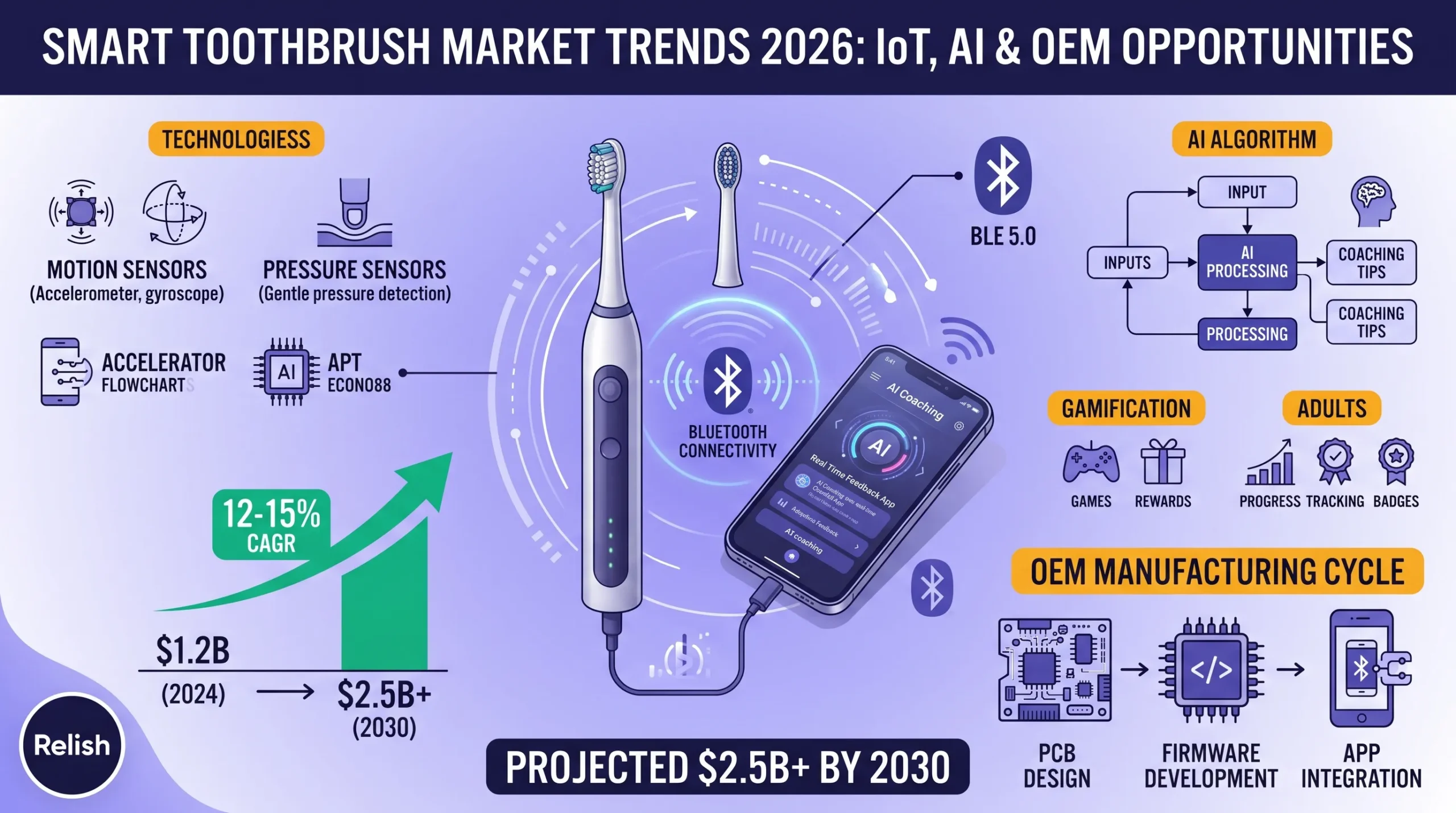
Der Markt für intelligente Zahnbürsten durchläuft einen grundlegenden Wandel. Was als Nischenkategorie begann, die von Premiummarken dominiert wurde, hat sich zu einem schnell reifenden Segment entwickelt, in dem künstliche Intelligenz, vernetzte Ökosysteme und gamifizierte Nutzerbindung die Erwartungen der Verbraucher neu definieren. Für OEM-Hersteller und Markenpartner ist das Verständnis dieser Veränderungen nicht länger optional – es ist eine strategische Notwendigkeit.
Im Jahr 2026 hat die Konvergenz sinkender Sensorkosten, reifer Bluetooth-Low-Energy-Ökosysteme und zunehmend ausgefeilter KI-Algorithmen beispiellose Möglichkeiten auf dem Markt für intelligente Zahnbürsten geschaffen, damit sich Marken durch intelligente Funktionen differenzieren können. Doch der Weg vom Konzept zum Verbraucher erfordert die Bewältigung komplexer technischer Herausforderungen, regulatorischer Anforderungen und sich schnell entwickelnder Verbrauchererwartungen. Diese umfassende Analyse untersucht die Technologietrends, Marktdynamiken und Fertigungsaspekte, die den Erfolg im Bereich der intelligenten Mundpflege definieren.
Was eine intelligente Zahnbürste im Jahr 2026 ausmacht
Die Definition einer "intelligenten Zahnbürste" hat sich im Vergleich zu frühen Bluetooth-fähigen Modellen, die lediglich die Putzdauer verfolgten, erheblich weiterentwickelt und spiegelt die schnelle technologische Reifung des Marktes für intelligente Zahnbürsten wider. Die heutigen intelligenten Zahnbürsten stellen eine Konvergenz von Präzisionstechnik, Sensortechnologie und Softwareintelligenz dar, die gemeinsam messbare Verbesserungen der Mundgesundheit liefern.
Im Kern integriert eine intelligente Zahnbürste vier wesentliche Technologiekomponenten, die sie von herkömmlichen elektrischen Modellen unterscheiden:
Bewegungssensoren
Moderne intelligente Zahnbürsten verwenden Beschleunigungssensoren und Gyroskope, um die Bewegung des Bürstenkopfes im dreidimensionalen Raum zu verfolgen. Diese MEMS-Sensoren (mikroelektromechanische Systeme) erkennen Vibrationsmuster, Putzgeschwindigkeit und Richtungsänderungen mit bemerkenswerter Präzision. Der Beschleunigungssensor misst lineare Beschleunigungskräfte, typischerweise im Bereich von ±2g bis ±16g, während das Gyroskop die Rotationsgeschwindigkeit erfasst, sodass Algorithmen die vollständige Putzbewegung rekonstruieren können.
Drucksensoren
Integrierte kraftempfindliche Widerstände oder piezoelektrische Sensoren überwachen den beim Putzen ausgeübten Druck. Diese Sensoren erfassen typischerweise Kräfte zwischen 0 und 300 Gramm und warnen den Benutzer, wenn der Druck die Schwelle von 150 Gramm überschreitet, die mit Zahnfleischschäden verbunden ist. Die Sensordaten speisen sowohl visuelles Echtzeit-Feedback (über LEDs am Griff) als auch eine Längsschnittverfolgung durch Begleit-Apps.
Bluetooth-Konnektivität
Bluetooth-Low-Energy-Module (BLE) ermöglichen eine kontinuierliche Kommunikation zwischen der Zahnbürste und den begleitenden Smartphone-Apps. Die Bluetooth-SIG-Spezifikationen definieren die Interoperabilitätsstandards, die dieses Ökosystem antreiben. Moderne Implementierungen verwenden BLE 5.0 oder höher und erreichen Datenübertragungsgeschwindigkeiten von bis zu 2 Mbit/s, während sie den geringen Stromverbrauch beibehalten, der für eine mehrwöchige Akkulaufzeit erforderlich ist. Die Verbindung ermöglicht Echtzeit-Coaching-Feedback, automatische Protokollierung von Putzsitzungen und nahtlose Datensynchronisation mit der Cloud-Speicherung.
Begleit-App
Die Softwareebene wandelt rohe Sensordaten in umsetzbare Benutzereinblicke um – eine Fähigkeit, die auf dem Markt für intelligente Zahnbürsten zunehmend erwartet wird. Begleit-Apps analysieren Putzmuster, identifizieren Abdeckungslücken, verfolgen Drucktrends im Zeitverlauf und liefern personalisierte Coaching-Empfehlungen. Viele Anwendungen integrieren Modelle des maschinellen Lernens, die Empfehlungen basierend auf gesammelten Benutzerdaten verbessern und so eine zunehmend personalisierte Mundpflegeberatung schaffen.
Marktübersicht für intelligente Zahnbürsten
Der globale Markt für intelligente Zahnbürsten repräsentiert eines der dynamischsten Segmente innerhalb der breiteren Mundpflegeindustrie. Das Verständnis der aktuellen Größe und der prognostizierten Entwicklung des Marktes liefert den wesentlichen Kontext für strategische Planung und Investitionsentscheidungen.
Laut Grand View Research (2025) repräsentiert der Markt für intelligente Zahnbürsten derzeit etwa 151 TP3T des gesamten Marktes für elektrische Zahnbürsten, ein Anteil, der weiter wächst, da intelligente Funktionen von Premium- in mittlere Preissegmente abwandern. Diese Durchdringungsrate spiegelt Muster wider, die in anderen Kategorien der Unterhaltungselektronik zu beobachten sind, wo Funktionen, die zunächst Flaggschiffprodukten vorbehalten waren, schließlich über alle Preissegmente hinweg zum Standard werden. Für OEM-Lieferanten stellt der Markt für intelligente Zahnbürsten die am schnellsten wachsende Unterkategorie in der Mundpflegefertigung dar.
Regionale Marktverteilung
Die Marktakzeptanz variiert erheblich je nach geografischer Region (Statista, 2025) und spiegelt Unterschiede bei der Akzeptanz von Verbrauchertechnologie, dem Gesundheitsbewusstsein und den verfügbaren Einkommen wider:
- Nordamerika (401 TP3T) — Höchste Akzeptanzraten, angetrieben durch eine starke Kultur der Technologieakzeptanz, etablierte Fitness-Tracking-Ökosysteme und ein hohes Bewusstsein für die Zusammenhänge zwischen Mund- und Allgemeingesundheit. Die USA führen bei den Downloads von Begleit-Apps und der Akzeptanz von Premium-Smart-Zahnbürsten.
- Europa (351 TP3T) — Starkes Wachstum, gestützt durch DSGVO-konforme Datenverarbeitung, zunehmende Befürwortung intelligenter Putzwerkzeuge durch Zahnärzte und strenge Umweltauflagen, die Präferenzen für langlebige Produkte fördern.
- Asien-Pazifik (201 TP3T) — Am schnellsten wachsende Region, insbesondere in China, Japan und Südkorea, wo Smartphone-Durchdringung und Technologievertrautheit günstige Bedingungen schaffen. Japan zeigt eine hohe Akzeptanz fortschrittlicher KI-Coaching-Funktionen.
- Übrige Welt (51 TP3T) — Schwellenländer zeigen erste Anzeichen einer Akzeptanz, insbesondere in städtischen Zentren, wo das Bewusstsein für Dentaltourismus und private Gesundheitsversorgung zunimmt.
Technologietrends, die das intelligente Segment vorantreiben
Die rasante Entwicklung der Smart-Zahnbürstentechnologie spiegelt breitere Trends in der Unterhaltungselektronik, künstlichen Intelligenz und vernetzten Gesundheitsgeräten wider. Sechs große Technologietrends verändern derzeit die Wettbewerbsdynamik und die Verbrauchererwartungen auf dem Smart-Zahnbürstenmarkt.
3a. KI-gestützte Putzanalyse
Künstliche Intelligenz stellt das bedeutendste technologische Unterscheidungsmerkmal im aktuellen Smart-Zahnbürstenmarkt dar und treibt die Differenzierung über Preissegmente hinweg voran. Die KI-gestützte Putzanalyse geht weit über einfache Timer-Funktionen hinaus und ermöglicht personalisiertes Coaching, das sich an das individuelle Nutzerverhalten anpasst und die Putzergebnisse messbar verbessert.
Zwei primäre technische Ansätze charakterisieren die KI-Implementierung auf dem Smart-Zahnbürstenmarkt:
Computer-Vision-Ansatz
Einige Hersteller haben mit integrierten Kameras experimentiert oder verlassen sich auf Smartphone-Kameras, um die Putztechnik zu analysieren. Der Benutzer positioniert sein Smartphone so, dass die Mundhöhle sichtbar ist, und Computer-Vision-Algorithmen identifizieren die geputzten Bereiche, Abdeckungsmuster und potenzielle Probleme. Dieser Ansatz ist zwar vielversprechend für die Präzision, steht jedoch vor praktischen Einschränkungen wie Positionierungsanforderungen, Lichtverhältnissen und Datenschutzbedenken.
Bewegungsanalyse-Ansatz
Die dominierende Implementierung analysiert Bewegungsmuster des Bürstenkopfes mittels Beschleunigungsmesser- und Gyroskopdaten. Maschinelle Lernmodelle, die mit Tausenden von Putzsitzungen trainiert wurden, können korrekte Techniken von ineffektiven Mustern unterscheiden und Probleme wie übermäßigen Druck, unzureichende Abdeckung und falsche Putzwinkel identifizieren. Dieser Ansatz erfordert keine zusätzliche Hardware über die Standardsensoren einer Smart-Zahnbürste hinaus.
Branchenbeispiele: The Philips Sonicare Diamond Clean 9900 employs AI-driven brush head recognition and adaptive cleaning modes that respond to detected brushing patterns. Oral-B's iO series uses AI algorithms to provide real-time guidance on brushing technique, with the app displaying coverage maps showing which areas have received adequate attention.
3b. Pressure Sensors & Real-Time Feedback
Pressure monitoring has become a foundational feature in the smart toothbrush market, addressing one of the most common causes of oral health problems: excessive brushing force. Clinical research consistently demonstrates that brushing with more than 150 grams of force significantly increases gum recession and enamel erosion risks (Journal of Clinical Periodontology, 2023).
Modern pressure sensing implementations provide multiple feedback channels:
- Visual Pressure Indicators — Color-coded LED rings on the toothbrush handle provide immediate, always-visible feedback. Green indicates optimal pressure, yellow signals attention needed, and red warns of excessive force.
- Haptic Feedback — Vibration pattern changes communicate pressure status without requiring visual attention, useful during blind brushing or for users with visual impairments.
- App Notifications — Silent pressure alerts through companion applications provide detailed feedback without disrupting the brushing experience. Many users find app-based feedback more actionable than handle indicators.
- Longitudinal Tracking — Pressure data aggregated over weeks and months reveals behavioral patterns that users can work to improve with professional guidance. In the smart toothbrush market, longitudinal pressure tracking has become a key feature differentiator.
3c. Bluetooth 5.0 & App Ecosystem Integration
The maturation of Bluetooth Low Energy technology has been instrumental in enabling practical functionality across the smart toothbrush market. BLE 5.0 and subsequent specifications deliver the combination of low power consumption, reliable connectivity, and sufficient bandwidth required for continuous sensor data transmission.
Key connectivity capabilities driving smart toothbrush adoption include:
Low-Energy Operation
BLE's power efficiency enables 14+ day battery life despite continuous sensor operation and regular data transmission. For the smart toothbrush market, extended battery life directly impacts consumer adoption rates. This represents a critical user experience requirement—consumers expect smart features without the inconvenience of frequent charging.
App Data Storage & Brushing History
Companion applications maintain comprehensive brushing histories that provide accountability and progress tracking. Across the smart toothbrush market, app quality increasingly determines brand success. Users can review brushing frequency, duration, technique scores, and pressure patterns across days, weeks, and months. This longitudinal data transforms toothbrushing from an anonymous daily routine into a trackable health behavior.
Multi-User Family Accounts
Family account features enable multiple household members to share a single toothbrush handle (with individual brush heads) while maintaining separate brushing profiles. This approach proves particularly valuable for families with children developing brushing habits, as parents can monitor compliance without constant supervision.
Cloud Synchronization
Data synchronization to cloud servers ensures brushing data persists across devices and survives device loss or replacement. Cloud storage also enables manufacturers to improve AI algorithms using aggregate anonymized user data, creating continuous product improvement cycles that benefit the entire smart toothbrush market.
3d. Gamification for Kids and Adults
Gamification has emerged as a powerful engagement strategy in the smart toothbrush market, addressing the fundamental challenge of maintaining consistent oral hygiene behavior change. Research published in the Journal of Dental Research (2024) demonstrates that gamified brushing approaches increase compliance rates by 30–40% compared to un gamified alternatives.
Brushing Timer Games
Interactive games synchronize with the brushing session, with progress tied to actual brushing time and technique. Completing the full two-minute dentist-recommended duration becomes an integral game mechanic rather than an abstract health guideline.
Rewards and Streaks
Drawing from fitness app design patterns, smart toothbrush apps award points, badges, and achievement unlocks for consistent brushing. Streak mechanics create momentum—users are motivated to maintain daily brushing sequences to avoid breaking established habits. Some apps incorporate charitable donation matching for brushing goals, adding social impact motivation.
Kid-Specific Models
Children's smart toothbrushes—a growing subsegment of the smart toothbrush market—emphasize engagement through character licensing, fun sound effects, and age-appropriate brushing modes. Disney, Marvel, and Star Wars collaborations transform toothbrushing into character-driven play experiences. Shorter brushing modes (90 seconds versus adult recommendations) accommodate younger attention spans while building foundation habits.
The gamification approach extends to adult products in the smart toothbrush market, though with more sophisticated reward structures. Adult gamification tends toward subtle achievements, progress visualization, and integration with broader health ecosystems rather than overt game mechanics.
3e. UV Sanitizing + Smart Charging
Beyond core brushing intelligence, manufacturers increasingly incorporate complementary technologies that enhance hygiene and user experience. UV sanitization and advanced charging systems represent two significant feature additions.
UV-C Sanitizing Stations
UV-C sanitizing docks, increasingly common in the smart toothbrush market, use short-wavelength ultraviolet light to reduce bacterial contamination on brush heads between uses. Advanced smart versions track sanitizing cycle completion, remind users to replace brush heads based on usage hours, and integrate sanitization status into app feedback. While independent UV sanitizers have existed for years, integrated smart versions add usage tracking and reminder functionality. For brands targeting eco-conscious consumers, our sustainability initiatives extend to packaging and component sourcing.
Smart Charging Docks
Intelligent charging systems—a growing feature in the smart toothbrush market—monitor battery health, optimize charging patterns to extend battery longevity, and provide usage feedback. Some premium docks incorporate wireless charging technology for cable-free convenience. Battery health monitoring helps users understand when battery capacity has degraded sufficiently to warrant replacement.
Key Players in Smart Oral Care
The competitive landscape for smart toothbrushes features a mix of established consumer goods giants with extensive R&D resources and innovative startups pushing technology boundaries. The smart toothbrush market spans from $25 value models to $349 premium devices. Understanding each player's positioning provides insight into market evolution and differentiation opportunities.
| Marke | Flagship Model | Key Smart Feature | Einzelhandelspreis | OEM Availability |
|---|---|---|---|---|
| Philips Sonicare | Diamond Clean 9900 | AI coaching, brush head recognition | $299–$349 | Begrenzt |
| Oral-B (P&G) | iO Series 9 | AI-powered pressure and coverage mapping | $249–$299 | Begrenzt |
| Foreo | BEAR Series | App-controlled intensity, facial-synced modes | $179–$299 | Selective |
| Colgate | Hum Smart Toothbrush | Affordable connected tracking, coaching | $49–$79 | Available |
| Gobrushing | Playbrush Smartseries | Gamification-first, kids' engagement | $39–$59 | Open Partnership |
| XFT | Smart Sonic Series | Value positioning, essential smart features | $25-$45 | Full OEM |
The table reveals a clear price stratification: premium brands (Philips, Oral-B, Foreo) command $179–$349 price points with advanced AI features, while value-oriented options (Colgate, Gobrushing, XFT) compete in the $25–$79 range with essential connected features. This stratification creates distinct market segments that OEM manufacturers in the smart toothbrush market can target with appropriate feature sets and pricing strategies.
OEM Manufacturing Challenges for Smart Toothbrushes
Manufacturing smart toothbrushes presents engineering challenges substantially different from conventional electric toothbrush production, distinguishing competitive suppliers in the smart toothbrush market. Our electric toothbrush OEM manufacturing guide details the full production workflow. The integration of sensors, wireless connectivity, and software introduces complexity that requires specialized expertise across multiple disciplines. For OEM buyers, typical lead time for standard smart platforms is 8–10 weeks, with custom feature development adding 4–6 weeks. All production undergoes AQL 1.5/2.5 sampling inspection before shipment.
PCB Design and Firmware
The printed circuit board (PCB) design for smart toothbrushes must balance multiple requirements, a technical challenge that defines the smart toothbrush market's manufacturing barrier to entry: small form factor to fit within ergonomic handles, low power consumption for extended battery life, reliable wireless connectivity, and robust signal integrity from sensors.
Microcontroller Unit Selection
MCU selection critically impacts both cost and capability. The Nordic Semiconductor nRF52 series has emerged as the de facto MCU standard across the smart toothbrush market, offering an optimal combination of integrated BLE capability, processing power, analog sensor interfaces, and power efficiency. Alternatives include STM32WB from STMicroelectronics and ESP32 from Espressif for cost-sensitive applications.
BLE Module Integration
Beyond MCU selection, BLE antenna design requires careful attention. In the competitive smart toothbrush market, RF performance directly impacts user experience ratings. Printed antenna designs on the PCB offer cost advantages but demand rigorous testing across usage positions. Ceramic chip antennas provide more consistent performance but increase component costs. Regulatory certification (FCC, CE) requires comprehensive RF testing that adds timeline and cost considerations. See our electric toothbrush certifications guide für detaillierte Anforderungen.
Firmware Development Lifecycle
Smart toothbrush firmware encompasses multiple subsystems: sensor data acquisition, BLE communication protocols, motor control, power management, and OTA update handling. For the smart toothbrush market, firmware quality is as critical as hardware reliability. Development typically requires 4–6 months for a complete feature set, with ongoing maintenance for bug fixes and security updates. OTA capability introduces additional complexity including secure boot implementation, encrypted firmware distribution, and rollback mechanisms.
App Development
Within the smart toothbrush market, the companion application represents the primary differentiator for brands yet constitutes the largest development cost. App development requires ongoing investment that extends well beyond initial launch.
Platform selection significantly impacts development approach. Native iOS (Swift) and Android (Kotlin) development provides optimal performance and platform feature access but requires parallel development efforts. Cross-platform frameworks including React Native and Flutter enable code sharing but may sacrifice performance optimization and native feature access.
Data Privacy Compliance represents a non-negotiable requirement. Health data falls under enhanced regulatory scrutiny in multiple jurisdictions:
- GDPR (EU) — Requires explicit consent for health data processing, data minimization principles, and right-to-erasure implementation
- CCPA (California) — Mandates privacy policy disclosure and consumer data access rights
- HIPAA (US, if applicable) — If data is shared with healthcare providers, additional security and access requirements apply
- App Store Requirements — Both Apple and Google require privacy disclosure and may classify health data apps as medical-adjacent
For OEM manufacturers without internal app development capabilities in the smart toothbrush market, strategic partnerships with specialized health app development firms offer the most reliable path to market. The key is selecting partners experienced specifically with connected health devices, not general mobile app developers.
Battery Life Optimization
Consumer expectations demand 14+ days between charges despite continuous sensor operation and regular BLE data transmission—a benchmark increasingly expected across the smart toothbrush market. Achieving this target requires systematic optimization across hardware selection, firmware design, and usage pattern management.
Target Specifications
- Active usage (2 brushing sessions daily): 14–21 days per charge
- Standby power consumption: < 50 μA average
- BLE advertisement power: optimized for connection efficiency
- Sensor activation latency: < 100ms from motion detection
Optimization Strategies
Battery life optimization begins with component selection—low-quiescent-current voltage regulators, efficient DC-DC converters, and power-gated sensor circuits. Firmware optimization implements aggressive sleep modes between brushing sessions, with wake-up triggered by motion detection rather than continuous polling. Battery capacity selection balances runtime requirements against weight and cost considerations.
Water Resistance (IPX7+) with Electronics
Smart toothbrushes face extreme environmental challenges: submersion in water, exposure to toothpaste residue, and temperature variations in bathroom environments. Meeting IPX7 certification is a baseline requirement for the smart toothbrush market. Achieving reliable water resistance while accommodating electronics represents a core manufacturing engineering challenge.
IPX7 Requirement
IPX7 certification requires that devices withstand 1 meter water immersion for 30 minutes without ingress. This demands comprehensive sealing at all openings: battery compartment, charging contacts, button interfaces, and product seams.
Sealing Technologies
- Ultrasonic Welding — Permanently joins plastic housing components without seals or adhesives. Requires precise mold design and controlled welding parameters.
- Potting Compound — Epoxy or silicone encapsulation protects PCB assemblies. Must be applied before battery installation and creates non-repairable assemblies.
- Gasket Seals — Silicone or TPE gaskets at mechanical interfaces provide reliable sealing but require careful assembly control and can degrade over time.
- Hydrophobic Coatings — Nanoscale coatings on PCB assemblies provide secondary protection against moisture intrusion through any seal imperfections.
Prüfanforderungen
IPX7 certification requires batch testing with production samples. Testing equipment includes pressure decay leak testers for production-line verification and full immersion testing for certification samples. OEM manufacturers must maintain testing capability on-site or partner with certified testing laboratories.
Sensor Calibration and Consistency
Success in the smart toothbrush market depends on consistent sensor performance. MEMS sensors exhibit inherent batch variation—accelerometers and gyroscopes from the same manufacturing lot may have offset biases and scale factors that impact measurement accuracy. Without calibration, brush tracking algorithms produce inconsistent results across production units.
Factory Calibration Process
Relish Tech implements automated calibration stations that characterize each sensor at assembly. The process involves placing toothbrushes in known orientations, measuring sensor outputs, computing correction factors, and storing calibration data in MCU non-volatile memory. This single-point calibration typically reduces measurement error by 80–90%.
Batch Variation Management
Beyond individual unit calibration, sensor lot changes require requalification of calibration parameters. Establishing preferred sensor lots with suppliers reduces variation and simplifies calibration procedures.
How Relish Tech Approaches Smart Toothbrush OEM
Relish Tech operates a 20,000m² ISO 13485:2016-certified facility in Shenzhen with 300+ staff and dedicated smart toothbrush assembly lines. Our platform approach enables brands to compete effectively in the smart toothbrush market regardless of their development stage. With 200+ smart toothbrush PCB designs delivered since 2020, our hardware engineering expertise combines with strategic partnerships that enable competitive smart toothbrush offerings.
In-House Capabilities
Our engineering team encompasses the complete skill set required for smart toothbrush development:
- PCB Design Team — Dedicated engineers with BLE and mixed-signal expertise design custom boards optimized for smart toothbrush applications. We maintain reference designs for common architectures while enabling customization for brand-specific requirements.
- Firmware Development — Embedded software engineers implement brush tracking algorithms, BLE protocols, motor control, and power management. OTA update infrastructure enables post-launch feature improvements and security patches.
- IPX7 Testing — On-site environmental testing facilities include pressure decay leak testers, temperature humidity chambers, and full immersion tanks. Certification testing is conducted with accredited external laboratories.
Strategic App Development Partnerships
Recognizing that app development requires specialized health technology expertise, Relish Tech has established partnerships with proven connected health app developers. This approach enables us to offer complete hardware and software solutions while ensuring app quality and regulatory compliance.
Our partnership model recognizes a fundamental truth: for smart toothbrush brands, the app is the primary differentiator while hardware enables the experience. By maintaining flexibility in app development partnerships, we ensure clients can differentiate through software while benefiting from our hardware platform expertise.
Prototype-to-Production Timeline
Smart toothbrush development from concept to production-ready product typically requires 6–9 months with Relish Tech's platform approach:
- Months 1–2 — Concept validation, specifications finalization, and component selection
- Months 3–4 — Prototype development and initial firmware implementation
- Months 5–6 — Design verification testing, firmware refinement, and app development initiation
- Months 7–8 — Pre-production tooling adjustments and pilot run
- Month 9 — Production qualification and launch readiness
Standardization Approach
To reduce development risk and accelerate time-to-market, Relish Tech offers a standardized base platform with modular smart module additions. Brands can select from established configurations:
- Essential Smart — BLE connectivity, basic brushing tracking, pressure feedback, essential app features
- Connected Coach — Enhanced sensors, AI brushing analysis, gamification, premium app experience
- Premium Smart — Full feature set including UV sanitizing integration, wireless charging, advanced AI coaching
This modular approach enables faster market entry with proven technology while preserving differentiation opportunities. For brands entering the smart toothbrush market, standardized platforms significantly reduce time-to-revenue.
Market Outlook: When Will Smart Become Standard?
The smart toothbrush market stands at an inflection point. After years of premium-only positioning within the smart toothbrush market, the technology fundamentals now support broader market penetration. Understanding the adoption curve trajectory enables strategic planning for brands and manufacturers alike.
Adoption Curve Projection
Based on comparable technology adoption patterns and current market dynamics, we project the following adoption phases:
- 2024–2026 (Current) — Early majority phase beginning. Smart features available across price tiers, with premium AI features still concentrated in flagship products.
- 2027–2028 — Mainstream adoption acceleration. Bluetooth connectivity becomes expected rather than exceptional in mid-range products ($50–$100).
- 2029–2030 — Market saturation for basic connectivity. Advanced AI coaching remains premium differentiator. Traditional non-connected electric toothbrushes become budget/niche segment.
Price Compression Dynamics
Component cost trends drive aggressive price compression throughout the smart toothbrush market:
- BLE Module Cost — Declined from $8–12 (2019) to $2–4 (2024), approaching $1 for high-volume applications by 2026
- Accelerometer/Gyroscope — Combined MEMS sensors now available under $1 in volume, down from $5+ five years ago
- Drucksensoren — Force-sensitive resistors under $0.50, enabling basic pressure sensing in value products
According to semiconductor industry analysis (IC Insights, 2024), total hardware bill-of-materials increase for basic smart features has declined from $25–40 (2019) to $15–25 (2024), with continued pressure toward $10–15 by 2027. This cost reduction enables smart feature integration in $35–55 retail products while maintaining healthy margins.
2030 Market Prediction
By 2030, we predict that 40%+ of mid-range electric toothbrushes (priced $35–55) will incorporate Bluetooth connectivity as a standard feature. The definition of "smart" will have shifted accordingly—basic connectivity and pressure feedback will be expected, while AI coaching sophistication will differentiate premium from value offerings.
For OEM manufacturers, this projection carries clear implications: the smart toothbrush market demands platforms that are no longer optional product lines but strategic necessities for remaining competitive across market segments.
OEM Sourcing Essentials — Smart Toothbrush
- MOQ: 1,000 units for established smart platforms; 2,500 units for moderate customization; 5,000+ for full custom development
- Vorlaufzeit: 8–10 weeks standard platform; 4–6 weeks additional for custom features; 2 weeks pre-shipment QA
- Factory: 20,000m² Shenzhen facility, 300+ staff, ISO 13485:2016 certified, dedicated smart toothbrush assembly lines
- QC: AQL 1.5 (critical defects) / AQL 2.5 (major defects); 100% functional testing for BLE connectivity and sensor calibration
- Zertifizierungen: FDA 510(k), CE Mark (MDR 2017/745), ISO 13485:2016, FCC Part 15, REACH, RoHS
Wichtigste Erkenntnisse
- Market Growth: Smart toothbrush market growing at 12–15% CAGR, projected to reach $2.5B+ by 2030
- AI Impact: AI coaching improves brushing consistency by 30–40% compared to manual guidance, driving consumer value perception
- Component Economics: BLE 5.0 and low-power sensors now cost-effective for mid-range models, enabling broader market access
- Kostenstruktur: App development is the primary cost driver ($30K–$150K); hardware BOM increase is only $15–40 for smart features
- Engineering Feasibility: IPX7 water resistance with embedded electronics is technically achievable with modern potting and ultrasonic welding techniques
- Market Trajectory: By 2030, Bluetooth connectivity will be standard in 40%+ of mid-range OEM electric toothbrushes, making the smart toothbrush market the default manufacturing category
Häufig gestellte Fragen
Was ist der Unterschied zwischen einer verbundenen Zahnbürste und einer intelligenten Zahnbürste?
Obwohl die Begriffe oft synonym verwendet werden, bezieht sich eine verbundene Zahnbürste typischerweise auf Geräte, die Bürstendaten einfach per Bluetooth an eine App übertragen und grundlegende Nachverfolgung und Verlauf bieten. Eine intelligente Zahnbürste geht weiter, indem sie KI-Algorithmen integriert, die Bürstmuster analysieren, Echtzeit-Coaching-Feedback geben und personalisierte Empfehlungen bieten. Intelligente Zahnbürsten nutzen fortschrittliche Sensoren und maschinelles Lernen, um die Technik des Benutzers aktiv zu verbessern, nicht nur aufzuzeichnen.
Wie viel kostet es, eine Smart-Toothbrush-App zu entwickeln?
Die Entwicklung einer voll funktionsfähigen Smart-Toothbrush-Begleit-App kostet in der Regel zwischen $30.000 und $150.000, abhängig von der Komplexität. Einfache Apps mit einfacher Putzverfolgung kosten $30.000–$50.000, während mittlere Apps mit KI-Coaching und Gamification $50.000–$100.000 kosten. Premium-Apps mit fortschrittlichem maschinellem Lernen, Multi-User-Unterstützung und Integration von Zahnpflegeexperten können $150.000 übersteigen. Die jährliche Wartung fügt weitere 15–20% der Entwicklungskosten für Updates und Plattformkompatibilität hinzu.
Welche Datenschutzbestimmungen gelten für Smart-Toothbrush-Apps?
Smart toothbrush apps collecting health data must comply with multiple regulations. In the EU, GDPR applies to all personal data processing, with special requirements for health data categorized as "special category" data under Article 9. In the US, CCPA applies to California residents, while FDA medical device classification and HIPAA may apply if data is shared with healthcare providers. App stores require privacy policy compliance, and apps handling health data may need medical device registration depending on intended claims. OEM manufacturers must ensure hardware and app designs support data privacy by design principles.
Wie optimiert Relish Tech die Akkulaufzeit bei intelligenten Zahnbürsten?
Relish Tech setzt mehrere Strategien ein, um eine Akkulaufzeit von 14+ Tagen zu erreichen. Wir wählen stromsparende Mikrocontroller wie die Nordic nRF52-Serie mit integriertem BLE, verwenden effiziente Sensorkonfigurationen, die nur während der Putzsitzungen aktiviert werden, implementieren ein intelligentes Energiemanagement, das zwischen den Anwendungen in den Tiefschlafmodus wechselt, und optimieren die Firmware, um die aktive Laufzeit zu minimieren. Unser Entwicklungsteam führt bereits früh in der Entwicklung eine Akkulaufzeitmodellierung durch und validiert diese vor der Produktionsfreigabe mit realen Nutzungstests.
What is the typical OEM minimum order quantity for smart electric toothbrushes?
MOQs for smart electric toothbrushes typically range from 1,000 to 5,000 units per SKU, higher than basic electric toothbrushes due to additional components and testing requirements. Relish Tech offers flexible MOQ structures: 1,000 units for established smart platforms with minor customization, 2,500 units for moderate feature modifications, and 5,000+ units for full custom smart development. Higher volumes significantly reduce per-unit costs, with 10,000+ unit orders seeing 20–30% cost reductions versus 1,000-unit orders.
When will smart toothbrush features become standard rather than premium?
The transition from premium to standard is already underway. By 2027–2028, smart features will enter the early majority adoption phase as component costs continue declining. We predict that by 2030, Bluetooth connectivity will be standard in 40%+ of mid-range electric toothbrushes (priced $35–55). Basic connected features (brushing timer, pressure feedback) will become table stakes, while advanced AI coaching will remain premium differentiators. OEM manufacturers should prepare smart-capable platforms now to remain competitive in this shifting market.
Referenzen
- Grand View Research. (2025). Smart Toothbrush Market Size, Share & Trends Analysis Report, 2025–2030. https://www.grandviewresearch.com/industry-analysis/smart-toothbrush-market
- Statista. (2025). Connected Oral Care Devices — Statistics & Facts. https://www.statista.com/topics/7290/connected-oral-care/
- Mordor Intelligence. (2025). Smart Toothbrush Market — Growth, Trends, and Forecasts (2025–2030). https://www.mordorintelligence.com/industry-reports/smart-toothbrush-market
- IEEE Standards Association. (2022). IEEE 802.15 — Wireless Personal Area Network Standards for Healthcare Applications. https://standards.ieee.org/standard/802_15_6-2012.html
- Koninklijke Philips N.V. (2024). Annual Report 2024 — Oral Healthcare Segment. https://www.results.philips.com/
- The Procter & Gamble Company. (2024). Annual Report 2024 — Oral Care Division. https://investor.pg.com/
- Journal of Clinical Periodontology. (2023). Brushing force and gingival recession: A systematic review and meta-analysis. Zeitschrift für klinische Parodontologie, 50(4), 412–426.