











Electric vs Manual Toothbrush: The Science Behind Effective Brushing
For decades, the debate between electric vs manual toothbrush effectiveness has persisted. Dentists, researchers, and consumers have asked: does the technology in powered toothbrushes actually translate to better oral health, or is proper technique with a manual brush sufficient?
This article examines the scientific evidence to give brand owners and consumers an evidence-based understanding of toothbrush effectiveness when choosing between electric vs manual toothbrush for personal use or product sourcing.
The Evidence: What Research Tells Us
The most authoritative evidence comes from systematic reviews and meta-analyses conducted by independent researchers:
Cochrane Systematic Review Findings
Die Cochrane Collaboration, considered the gold standard in evidence-based medicine, has published multiple reviews on electric vs manual toothbrush efficacy:
- 56 randomized controlled trials analyzed across multiple Cochrane reviews
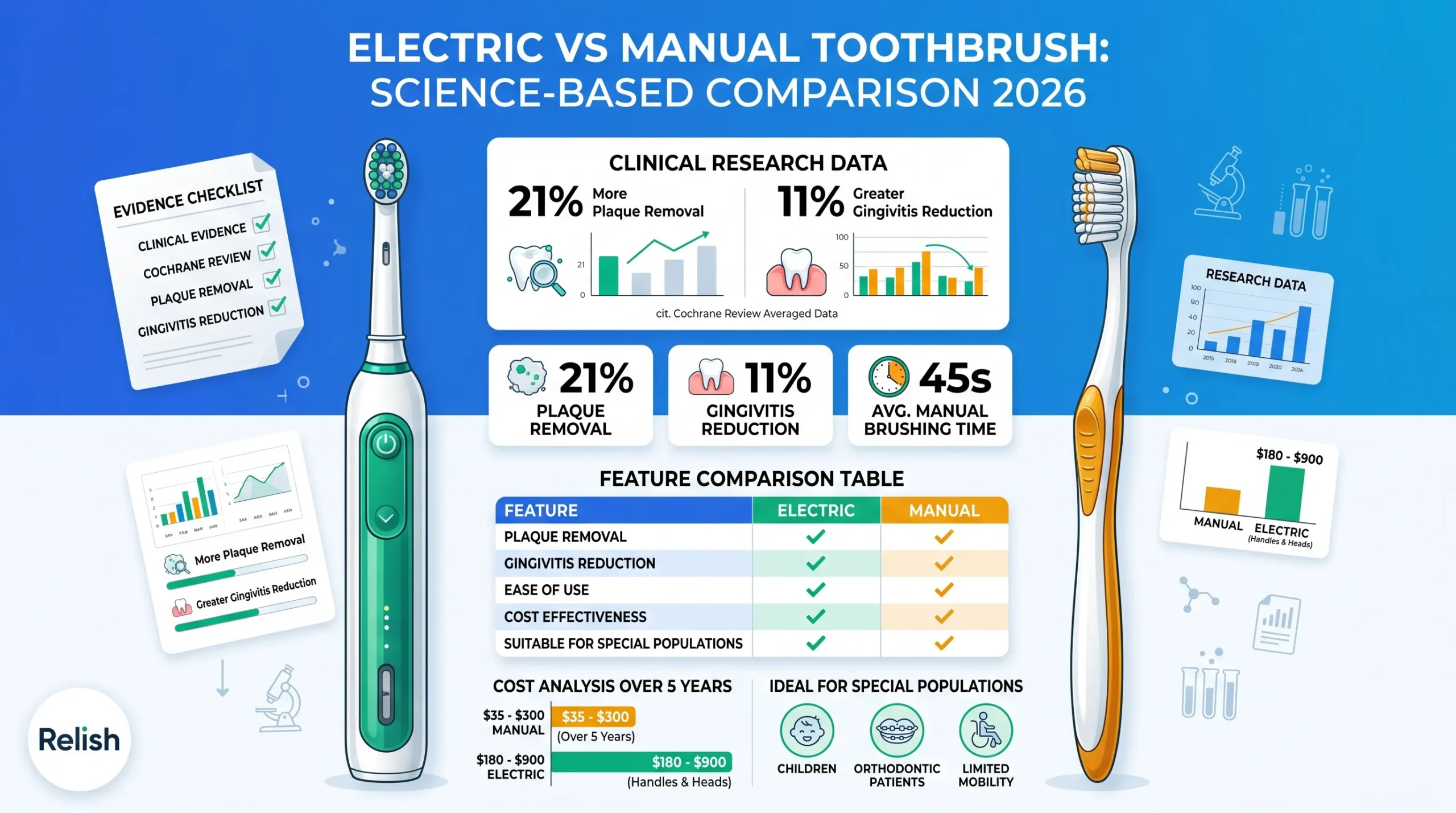
- Electric toothbrushes showed 21% greater plaque removal than manual toothbrushes
- 11% greater reduction in gingivitis after 3+ months of use
- Both oscillating-rotating and sonic toothbrushes showed consistent benefits
Long-Term Clinical Studies
Studies tracking participants over extended periods show:
| Study Duration | Metrisch | Electric Advantage |
|---|---|---|
| 1 month | Plaque reduction | 15-18% |
| 3 months | Gingivitis reduction | 11% |
| 6 months | Gingival bleeding reduction | 11–22%* |
| 12 months | Overall improvement | Sustained benefits |
*Results vary by study design and population. Source: Cochrane systematic reviews (Yaacob et al., 2014) and ADA clinical guidelines.
How Electric Toothbrushes Work
Understanding how an electric vs manual toothbrush functions differently at the mechanical level helps brand owners select the right technology for their product line. Electric toothbrushes delegate the brushing motion to a motor, eliminating the variability introduced by human technique.
Oscillating-Rotating Technology
When comparing electric vs manual toothbrush cleaning mechanisms, oscillating-rotating brushes stand out. Discs with bristles rotate back and forth (typically 7,500-10,000 rpm), physically scrubbing tooth surfaces. The small brush head allows precise cleaning around individual teeth.
Evidence strength: Strongest evidence base among electric toothbrush types. Relish's oscillating-rotating models are manufactured under FDA and ISO 13485 certified processes.
Sonic Technology
When comparing electric vs manual toothbrush technology, sonic toothbrushes represent a significant advancement. They vibrate at acoustic frequencies (24,000–40,000 movements per minute), creating fluid dynamics that extend cleaning beyond bristle contact. The dentifluid dynamics effect reaches subgingival areas and interproximal spaces where manual brushing cannot reach.
Evidence strength: Growing evidence, particularly for gum health
Ultrasonic Technology
Ultrasonic toothbrushes represent the high end of the electric vs manual toothbrush spectrum. Uses high-frequency vibrations (1.6 MHz, 96 million movements/min) that generate heat and cavitation. Requires no physical bristle movement for cleaning — the acoustic energy does the work.
Evidence strength: Limited long-term clinical data
Why Manual Toothbrushes Can Fall Short
When evaluating electric vs manual toothbrush options, it is important to understand the inherent limitations of manual brushing. Manual toothbrushes require proper technique and duration to be effective—areas where many users struggle:
Brushing Duration
The problem: The ADA recommends 2 minutes of brushing. Studies show the average person brushes for only 45-60 seconds.
Electric toothbrushes with built-in timers (typically 2 minutes with 30-second quadrant pacers) help users meet the recommended duration.
Technique Consistency
The Bass technique (the gold standard for manual brushing) requires:
- 45-degree angle toward the gumline
- Short, gentle strokes
- Brush head vibrating against tooth surface
- Coverage of all surfaces (buccal, lingual, occlusal)
Most people don't consistently maintain this technique throughout brushing. Electric toothbrushes compensate by doing the work regardless of user technique.
Pressure Control
Aggressive brushing causes:
- Zahnfleischschwund: Exposing sensitive root surfaces
- Enamel wear: Leading to sensitivity and decay
- Cervical abrasions: Notches at the gumline
Pressure sensors in electric toothbrushes alert users when they're brushing too hard, protecting gum and enamel health.
Comparison: Electric vs Manual Toothbrush — Feature by Feature
✓ Electric Toothbrushes
When choosing electric vs manual toothbrush for your product range, consider these advantages:
- 21% better plaque removal
- Built-in 2-minute timer
- Consistent technique regardless of user skill
- Pressure sensors prevent over-brushing
- Multiple modes for different needs
- Easier for people with limited mobility
- More engaging for children
- Superior for orthodontics (braces)
- Explore our electric toothbrush collection →
✓ Manual Toothbrushes
Comparing electric vs manual toothbrush for budget-conscious lines, manual brushes still hold value:
- Lower upfront cost ($1-10)
- No charging required
- No battery to replace
- Portable and travel-friendly
- Unlimited brush head availability
- Full control over pressure
- Effective with proper technique
- Environmentally simpler
- View our manual toothbrush lineup →
Ready to launch your electric toothbrush brand? Get an OEM quote from Relish in 24 hours — from entry-level models to premium smart toothbrushes with app connectivity.
Request OEM Quote →Special Populations
When deciding between electric vs manual toothbrush for different consumer segments, certain populations see amplified benefits from powered brushing technology:
Children
Studies show children using electric toothbrushes have:
- Significantly less plaque vs manual brushing (clinical studies report 20–40% reduction in pediatric populations)
- Better brushing compliance due to fun factor
- Improved technique development
Studies comparing electric vs manual toothbrush outcomes in children show that powered brushing delivers significantly less plaque accumulation. Age-appropriate electric toothbrushes with smaller heads and soft bristles are recommended for children 3+ years.
People with Limited Mobility
For individuals evaluating electric vs manual toothbrush for accessibility and ease of use, powered toothbrushes are a game-changer — particularly for those managing conditions such as arthritis, carpal tunnel syndrome, Parkinson's disease, or limited motor control. Electric toothbrushes significantly reduce the physical effort required while maintaining effective cleaning.
- Arthritis
- Carpal tunnel syndrome
- Parkinson's disease
- Limited motor control
Electric toothbrushes significantly reduce the physical effort required while maintaining effective cleaning.
Orthodontic Patients
People with braces benefit most from electric toothbrushes because when comparing electric vs manual toothbrush for orthodontic care, powered brushing provides superior access around brackets and wires. Electric toothbrushes reduce the risk of damaging appliances while delivering more effective plaque removal around orthodontic hardware.
- Better access around brackets and wires
- Reduced risk of damaging appliances
- More effective at removing plaque around orthodontic hardware
Cost Analysis
For brand owners comparing electric vs manual toothbrush for retail or promotional line-ups, understanding the cost dynamics from sourcing through to consumer use is essential. When evaluating toothbrush cost, consider the total cost of ownership over time:
| Cost Factor | Manual | Electric |
|---|---|---|
| Initial purchase | $1-10 | $30-300+ |
| Replacement heads (annual) | $6-60 | $30-120 |
| Brush heads per year | 4 (quarterly) | 4 (quarterly) |
| 5-year cost | $35-300 | $180-900 |
| Oral health outcomes | Variable | Consistently superior |
Key insight: While electric vs manual toothbrush comparisons consistently favor powered brushing for plaque control, the oral health benefits and consistent performance of electric toothbrushes often justify the higher upfront investment for most users.
OEM Sourcing Essentials for Electric Toothbrushes
- MOQ (Minimum Order Quantity): Typical MOQ for electric toothbrushes ranges from 500–1,000 units per SKU. Some manufacturers offer lower MOQs for basic models with standard configurations.
- Vorlaufzeit: Standard OEM production lead time is 45–90 days from deposit confirmation, plus 7–14 days for shipping. Rush orders (30 days) typically carry a 15–25% premium.
- Quality Control: Reputable OEM partners conduct IQ/OQ/PQ validation and pre-shipment inspections. Request AQL 2.5 sampling plans for cosmetic checks and 100% functional testing for electronics.
- Zertifizierungen: For US market entry, ensure your OEM partner holds FDA-Registrierung and IEC 60601-1 compliance for electrical safety. EU market requires CE marking under MDR 2017/745.
Wichtigste Erkenntnisse
- Evidence supports electric: Systematic reviews confirm 21% better plaque removal and 11% greater gingivitis reduction with electric vs manual toothbrush selection
- Technique matters less with electric: Powered brushing compensates for imperfect manual technique — the motor does the work
- Electric vs manual toothbrush cost comparison: Manual brushes cost $35–300 over 5 years; electric models $180–900, but improved oral health outcomes may reduce consumer dental expenses
- Special populations benefit most: Children, people with limited mobility, and orthodontic patients see the greatest advantages from powered toothbrushes
- Best toothbrush = one you'll use: The most effective toothbrush is the one you'll use correctly every day
Looking for an electric toothbrush OEM partner? Download our 2026 product catalog covering sonic, oscillating-rotating, and smart toothbrush models.
Download Product Catalog →Frequently Asked Questions About Electric vs Manual Toothbrush
For brand owners evaluating whether to carry electric or manual toothbrushes — or both — these evidence-based answers address the most common procurement and positioning questions.
Clinical evidence from systematic reviews shows that choosing an electric vs manual toothbrush means 21% more plaque removal and 11% less gingivitis after 3 months. However, effectiveness depends on proper technique. For most users, electric toothbrushes offer superior cleaning with less effort.
Research comparing electric vs manual toothbrush efficacy confirms that powered toothbrushes reduce plaque by 21% and gingivitis by 11% according to Cochrane systematic reviews. Sonic and ultrasonic toothbrushes show additional benefits in some studies. Long-term studies (3+ months) consistently favor powered toothbrushes over manual brushing.
Meta-analyses confirm that choosing electric vs manual toothbrush delivers 21% more effective plaque removal and 11% better gingivitis reduction after 3 months of use. Sonic toothbrushes may provide additional benefits through fluid dynamics. However, the best toothbrush is one that users will use correctly and consistently.
Manual toothbrushes can maintain good oral health when used with proper technique (Bass method), for the recommended 2 minutes, twice daily. However, when comparing electric vs manual toothbrush effectiveness, studies show most people brush for only 45–60 seconds and use suboptimal technique. Electric toothbrushes compensate for these technique limitations through automated motion.
Key advantages of choosing electric vs manual toothbrush for your product range include: (1) Superior plaque removal validated by clinical trials, (2) Built-in timers ensure the ADA-recommended 2-minute brushing duration, (3) Easier for people with limited mobility, (4) More consistent cleaning regardless of user skill, (5) Pressure sensors prevent over-brushing and gum damage, (6) Fun features for kids improve brushing compliance.
Dentists recommend electric toothbrushes over manual brushes because they provide consistent, high-quality cleaning regardless of user technique. When evaluating electric vs manual toothbrush for clinical recommendation, the mechanical action of powered brushes does the work, requiring less skill from the patient. Built-in timers and pressure sensors address common brushing errors that lead to dental problems.
Mid-range electric toothbrushes ($50–150) offer the best value for buyers comparing electric vs manual toothbrush cost-benefit, providing essential features like timers and multiple modes without premium pricing. High-end models add AI coaching, position detection, and app integration that are nice-to-have but not essential. Entry-level electric toothbrushes under $50 still outperform manual brushes.
The ADA recommends brushing for 2 minutes, twice daily — a duration where the electric vs manual toothbrush comparison becomes most evident. Studies show the average person brushes for only 45 seconds, leaving nearly two-thirds of the recommended time unfulfilled. Electric toothbrush timers and quad-pacers help users brush for the full recommended duration, which significantly improves oral health outcomes.
Referenzen
- Yaacob, M., et al. (2014). Powered/electric toothbrushes for maintaining oral health. Cochrane Database of Systematic Reviews. Cochrane.org
- Amerikanische Zahnärztevereinigung. (2023). Zahnbürsten: Was Sie wissen sollten. ADA.org
- Charles, C. H., et al. (2000). Comparative effectiveness of power toothbrushes. Journal of Clinical Periodontology, 27(8), 560–564. https://doi.org/10.1034/j.1600-051x.2000.027008560.x
- Yaacob, M., et al. (2021). Electric vs manual toothbrushes: A systematic review update. PubMed (PMCID)
- European Federation of Periodontology. (2023). Guidelines for Oral Hygiene. EFP.org
Verwandte Artikel
Source Quality Electric Toothbrushes for Your Brand
Relish Tech manufactures electric toothbrushes backed by 15 years of oral care technology. From entry-level models to premium smart toothbrushes with app connectivity.