

OEM BUYER RESOURCES
Before booking an electric toothbrush shipment, connect the final product specification, battery evidence and carton details in one document pack. Give your supplier and freight forwarder the same information so they can review the goods you will actually ship.
A private-label order can include several handle colors, a charging case and different retail bundles. Start with a clear record of each stock-keeping unit (SKU) and its configuration. A document named “battery certificate” tells the buyer little unless it can be matched to the approved product.
This checklist helps oral-care brand owners, importers and purchasing teams organize that handover. It focuses on electric toothbrushes using lithium-ion cells or batteries. Ask a qualified forwarder to confirm the applicable transport rules and carrier acceptance for the actual shipment.
1. Describe the shipment before requesting documents
Send the factory a short shipment brief alongside your purchase order. Include the toothbrush model, battery configuration, retail bundle, quantity, destination and preferred transport mode. Identify the person who will coordinate freight.
IATA’s 2026 air-transport flowchart separates batteries shipped alone, packed with equipment, and contained in equipment. It lists UN 3481 for the latter two lithium-ion configurations. Ask the forwarder to confirm the description and packing instruction. IATA 2026 guidance, page 10.
Describe any battery-powered travel case or loose replacement battery separately. Include photos showing how the product and accessories sit inside the retail box. This gives the reviewer a concrete packing arrangement to assess.
If you are still choosing the handle, compare Relish’s private-label electric toothbrush platforms before freezing the shipping brief.
2. Build a document pack with clear owners
Use the following as a procurement checklist. Agree the final document list with your importer, broker and forwarder for the destination and route. The U.S. International Trade Administration also recommends starting with the importer or forwarder to establish which documents a shipment needs. Common Export Documents.
| Record to request | Buyer’s check | Suggested coordinator |
|---|---|---|
| Final product and battery specification | Connect each sales SKU to the factory model and the installed cell or battery model. | Supplier engineering and buyer |
| UN 38.3 test summary | Check the model identity, report reference and coverage against the agreed configuration. | Supplier, with battery manufacturer support |
| Commercial invoice | Reconcile the description, quantity, value and parties with the order and broker’s instructions. | Seller and buyer |
| Packing list | Match SKU quantities, carton count, dimensions and weights to the packed goods. | Supplier packing team |
| Transport review and booking record | Record the route, packing arrangement, carrier requirements and booking validity. | Shipper and qualified forwarder |
| Destination or customer-specific records | Confirm which origin documents, product records and warehouse labels apply to this order. | Importer, broker and buyer |
| Final packing photos and release record | Keep a traceable view of carton markings, packing and outstanding actions. | Supplier and buyer |
The suggested coordinators are a working arrangement. Write the agreed responsibilities into your order or shipping instructions. Assign a named owner and a due date to each unresolved item.
3. Match the UN 38.3 test summary to the product
PHMSA explains that lithium batteries undergo design testing under subsection 38.3 of the UN Manual of Tests and Criteria. Its test-summary resource helps manufacturers and distributors understand the related documentation requirement. PHMSA: Lithium Battery Test Summaries.
For your purchase file, ask the supplier to identify the exact cell or battery used in production. Keep a mapping between your branded SKU, the factory product model and the battery model. This mapping is a practical buyer control for checking document coverage.
IATA’s checklist covers manufacturer and laboratory details, report identification, battery description, ratings, test results and responsible-person details. Check completeness and clarify model mismatches. IATA 2026 guidance, page 9.
Keep the test summary, supporting reports and supplier correspondence under distinct file names. PHMSA’s published interpretation explains that a general statement saying a battery passed testing does not meet the manufacturer or distributor’s obligation to make a test summary available. PHMSA interpretation 22-0044, answers 1–3.
4. Ask the forwarder to record the transport review
Provide the shipment brief and available documents before confirming collection. Ask the forwarder to identify the applicable packing instruction, marks, labels and declaration requirements, plus any carrier-specific conditions. Include the required charge-state arrangements in that review.
Keep the carrier or forwarder’s response with the exact packing version reviewed. If you change the carton layout, add a powered accessory or switch from sea freight to air freight, request an updated review before dispatch.
Some logistics providers request a safety data sheet, often called an SDS or MSDS. IATA says an SDS is not a transport document or required by its battery-transport rules. Clarify separate provider requests and retain the UN 38.3 evidence. IATA 2026 guidance, FAQ G.01.
For a sea shipment, obtain a review against the applicable sea-transport requirements. Keep mode-specific instructions beside the booking they support.
5. Reconcile the documents with the packed order
Once packing is complete, compare the invoice and packing list with the actual shipment. Check the quantity of each color or bundle, the number of cartons, carton measurements and gross weights. Confirm the receiving address and delivery instructions with the buyer’s logistics contact.
A useful internal review has two parts: the factory checks the packed goods, and the buyer checks the commercial and receiving details. Send discrepancies back as specific actions, such as “revise the blue-handle quantity” or “confirm the charging-case battery model.”
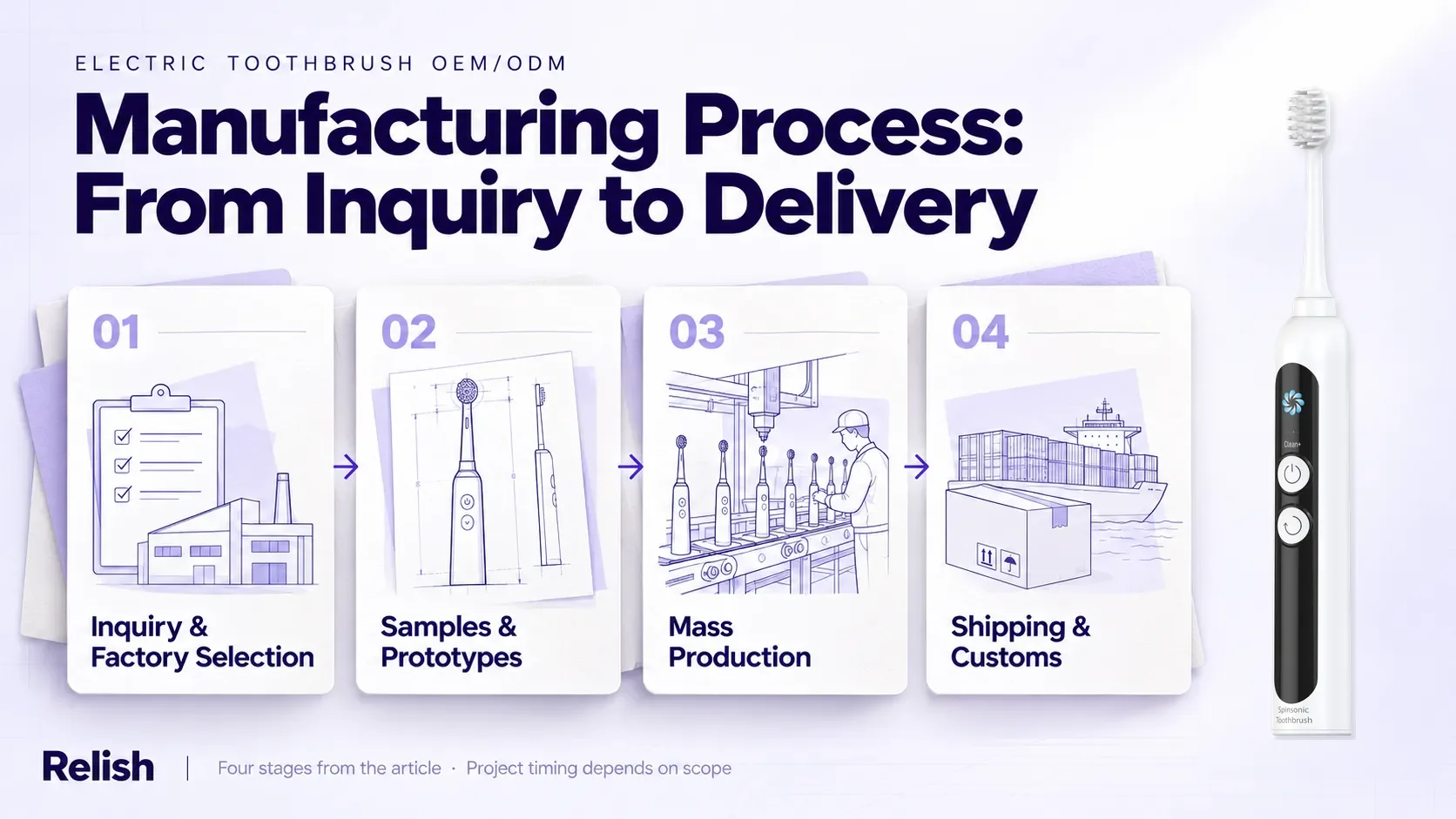
Coordinate this handover with your OEM electric toothbrush project timeline. Set document-review and cargo-release milestones in the project schedule, with dates agreed for the actual order.
6. Recheck the pack after a configuration change
Keep the shipping document pack linked to the approved specification. Ask engineering and logistics to review the effect of a battery supplier change, a new charging case, a revised bundle or a different packing layout.
For example, a repeat order might keep the same outer handle while changing the installed battery model. Record the change and request confirmation of the supporting evidence before release.
Give each approved pack a version and record the order it covers. Preserve the earlier version so your team can trace what supported each shipment.
A shipping brief you can send with your inquiry
Copy these fields into your supplier brief. Fill in confirmed information and mark open points for discussion.
- Product: factory model, branded SKU, colors and retail bundle.
- Akku: chemistry, model, rated voltage and capacity, watt-hour rating, and installed or separately packed arrangement.
- Order: quantity by SKU, intended destination and required arrival date.
- Transport: preferred mode, forwarder contact and delivery responsibilities to agree.
- Nachweise: available UN 38.3 test summary and questions about model coverage.
- Packing: units per carton, dimensions, weights and receiving-label instructions.
- Open actions: missing information, responsible person and target review date.
Buyer questions
Does a built-in battery remove the need for a test summary?
IATA’s FAQ C.01 says the test-summary provision covers lithium cells and batteries contained in equipment, with an exception for equipment containing only lithium button cells. Ask for evidence covering the actual battery configuration. IATA 2026 guidance, page 20.
Can I reuse the shipping pack for a repeat order?
Use the earlier pack as your starting point. Reconfirm the product configuration, current route and packing requirements, then update the order-specific commercial and carton information.
What should I send Relish before requesting a shipping quote?
Send the selected model or product requirements, quantity, destination, customization scope and preferred shipping mode. Relish’s OEM/ODM FAQ describes checking battery configuration, quantity and packing with the carrier and preparing applicable battery documents.
Plan your electric toothbrush order with the shipping brief included
Relish supports oral-care OEM/ODM projects, including electric toothbrushes and water flossers. Share your model, quantity, destination and branding requirements so the product discussion includes the documents and packing your shipment needs.
Transport references checked on 13 November 2026. Confirm the current requirements and acceptance for your shipment with the qualified shipper, forwarder and carrier before dispatch.