







Beschaffung von Mundpflegeprodukten aus China:
Vollständiger B2B-Leitfaden 2026
Um Mundpflegeprodukte aus China zu beziehen, muss man wissen, welche Städte man anvisieren sollte, wie man Fabriken überprüft und wie man den Schutz des geistigen Eigentums strukturiert, bevor man Designs weitergibt. Dieser Leitfaden deckt den gesamten Prozess ab - von der Identifizierung des richtigen Herstellers bis hin zur Verhandlung von Mindestmengen, dem Verständnis von Zertifizierungen und dem Management der Qualitätskontrolle - basierend auf mehr als 15 Jahren Erfahrung in der Herstellung von Mundpflegeprodukten in Shenzhen.
Wichtigste Erkenntnisse
- Beschaffung von Mundpflegeprodukten aus China beginnt mit der Wahl der richtigen Region: Shenzhen und das Perlflussdelta beherbergen das dichteste Komponenten-Ökosystem der Welt
- Erstklassige Hersteller verfügen über ISO 13485-, FDA-Zulassungs- und CE-Zertifikate - überprüfen Sie dies immer vor der Bestellung.
- Typisches MOQ: 500-5.000 Stück OEM / 2.000-10.000 Stück ODM (kundenspezifische Werkzeuge)
- Unterzeichnung einer NNN-Vereinbarung vor der Freigabe von Entwürfen - nach chinesischem Vertragsrecht einklagbar
- Haushalt 4-5 Monate vom ersten Kontakt bis zur Ankunft im Lager für die Einführung eines neuen Produkts
- Defektraten unter 0.3% sind mit zertifizierten Herstellern und AQL-Inspektion erreichbar
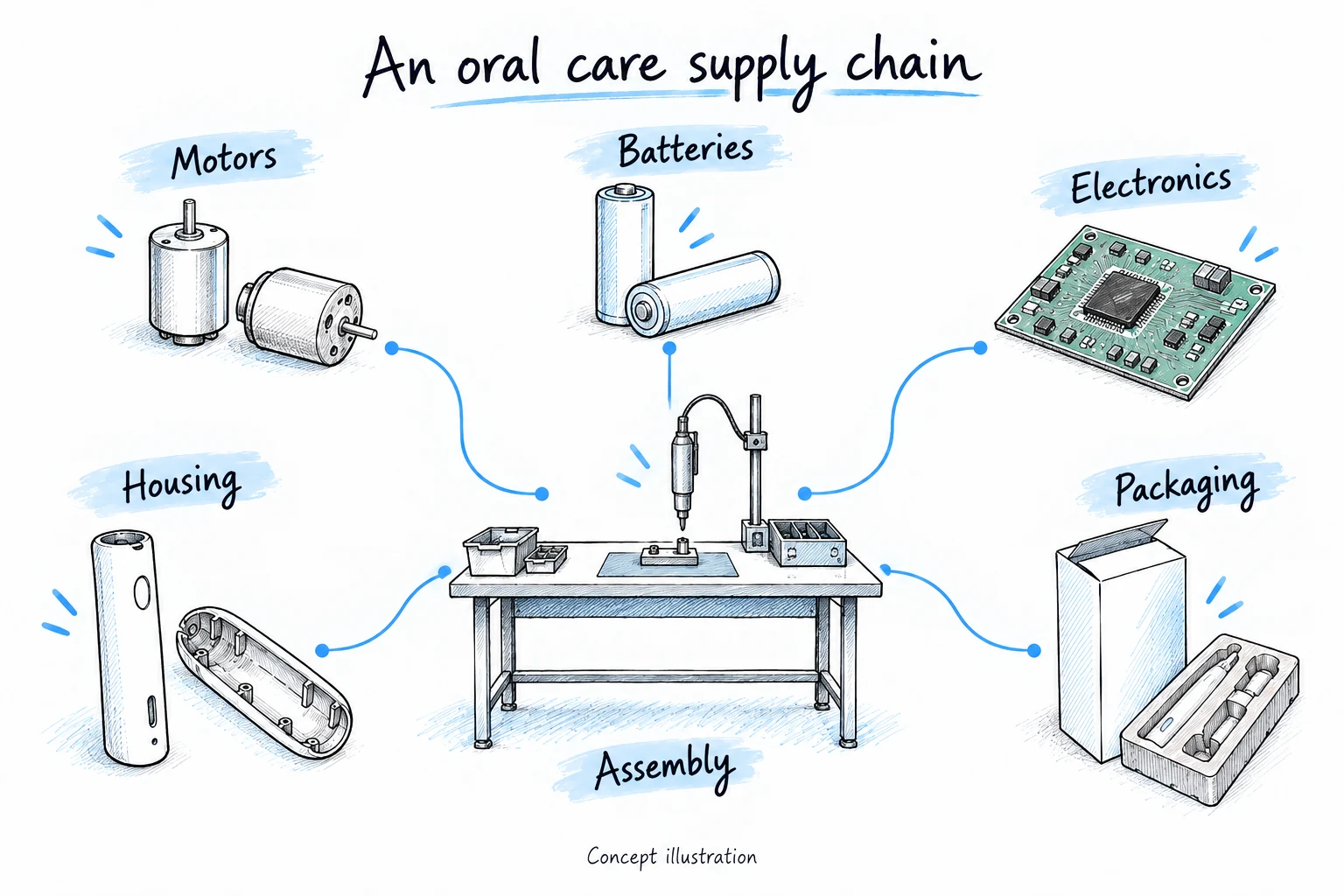
Beschaffung von Mundpflegeprodukten aus China ist die vorherrschende Beschaffungsstrategie für Marken elektrischer Zahnbürsten und Zahnseidegeräte weltweit - und das aus gutem Grund. In der chinesischen Provinz Guangdong, insbesondere in Shenzhen und den umliegenden Städten, befindet sich die weltweit kompletteste Lieferkette für Mundpflegeprodukte: Motorlieferanten, Batteriehersteller, Kunststoffspritzgussfabriken, Leiterplattenhersteller und komplette Montagewerke - alles in einem Umkreis von 50 Kilometern. Diese Dichte führt direkt zu einer Kosteneffizienz, Prototyping-Geschwindigkeit und Fertigungsflexibilität, die in keinem anderen Land erreicht werden kann.
Aber Beschaffung von Mundpflegeprodukten aus China ist nicht ohne Risiko. Die Qualität in den Fabriken ist sehr unterschiedlich. Der Diebstahl von geistigem Eigentum, minderwertige Komponenten und die Nichteinhaltung von Vorschriften können eine Marke zerstören, bevor sie auf den Markt kommt. Dieser Leitfaden fasst die wesentlichen Kenntnisse zusammen, die jeder Markeninhaber benötigt, um Mundpflegeprodukte sicher, effizient und gewinnbringend aus China zu beziehen.
Warum China die Herstellung von Mundpflegeprodukten dominiert
Verstehen warum China leads hilft Ihnen, seine Stärken zu nutzen, anstatt sie einfach als gegeben hinzunehmen. Wenn Beschaffung von Mundpflegeprodukten aus China, Die Kenntnis der geografischen und strukturellen Vorteile bestimmter Städte beeinflusst jede nachgelagerte Entscheidung.
Der Vorteil der Shenzhener Lieferkette
Beschaffung von Mundpflegeprodukten aus China bedeutet, dass die Region des Perlflussdeltas in Shenzhen, in der etwa 65% der elektrischen Zahnbürsten der Welt (Grand View Research, 2025). Die Konzentration spezialisierter Anbieter ist weltweit unübertroffen:
If the table is not fully visible, scroll horizontally to view all columns.
| Komponente | Lieferanten im Raum Shenzhen | Vorlaufzeit | Kosten vs. Importe |
|---|---|---|---|
| DC-Motoren (akustisch/oszillierend) | 50+ | 3-7 Tage | 40-60% unten |
| Lithium-Ionen-Batterien | 80+ | 5-10 Tage | 30-50% unten |
| PCB / Elektronische Steuerung | 200+ | 5-15 Tage | 35-55% unten |
| ABS/PC-Spritzgießen | 150+ | 7-21 Tage | 25-40% unten |
| Nylon-Borsten | 30+ | 5-10 Tage | 30-45% unten |
| Verpackung (Einzelhandelskartons) | 200+ | 5-14 Tage | 20-35% unten |
Das Ökosystem der Mundpflegeherstellung in Shenzhen schafft einen sich selbst verstärkenden Vorteil für Beschaffung von Mundpflegeprodukten aus ChinaDie Konzentration der Zulieferer zieht Montagefabriken an; die Dichte der Montagefabriken zieht weitere Zulieferer an; die Tiefe des Ökosystems zieht F&E-Talente und schnelle Prototyping-Fähigkeiten an. Im Laufe von vier Jahrzehnten hat Shenzhen die höchste Konzentration von Produktionskapazitäten für elektrische Zahnbürsten und Zahnseide in einer Stadt weltweit aufgebaut - und diese Dichte lässt sich anderswo nur schwer in großem Maßstab wiederholen.
Diese Dichte der Lieferkette ermöglicht es einer Fabrik in Shenzhen, den Prototyp einer neuen elektrischen Zahnbürste in 2-4 Wochen, im Vergleich zu 8-16 Wochen in Europa oder Nordamerika. Für Markeninhaber, die im Wettbewerb um die Markteinführungszeit stehen, ist dies allein schon eine Umstellung.
Kostenökonomie
Die Fabrikkosten für elektrische Zahnbürsten von verifizierten chinesischen OEM-Lieferanten liegen in der Regel bei $6-$28 pro Stück je nach Technologie und Ausstattung. Wasserflosser reichen von $8-$35 pro Einheit. Diese FOB-Preise beinhalten Montage, grundlegende Qualitätskontrolle und Standardverpackung.
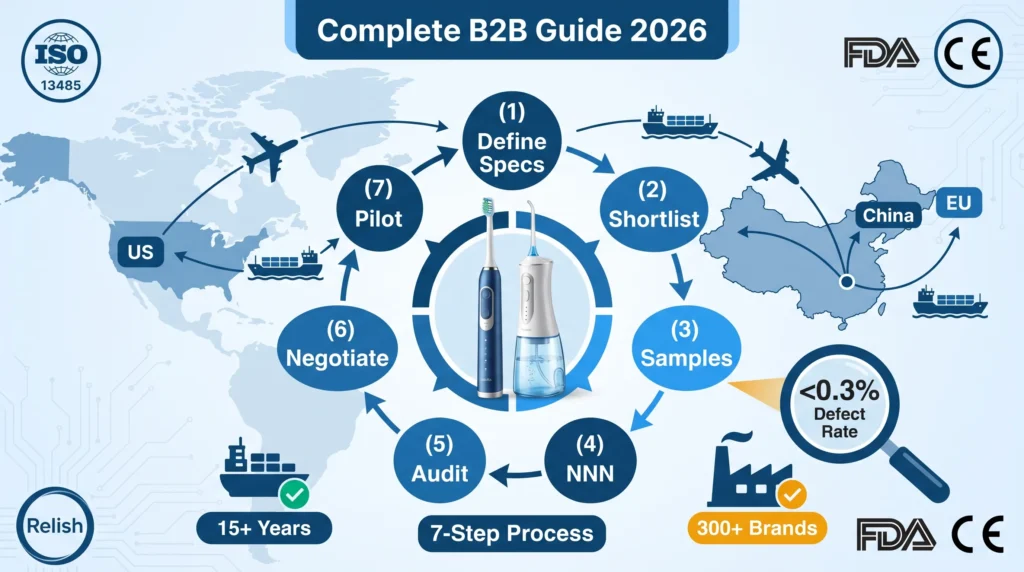
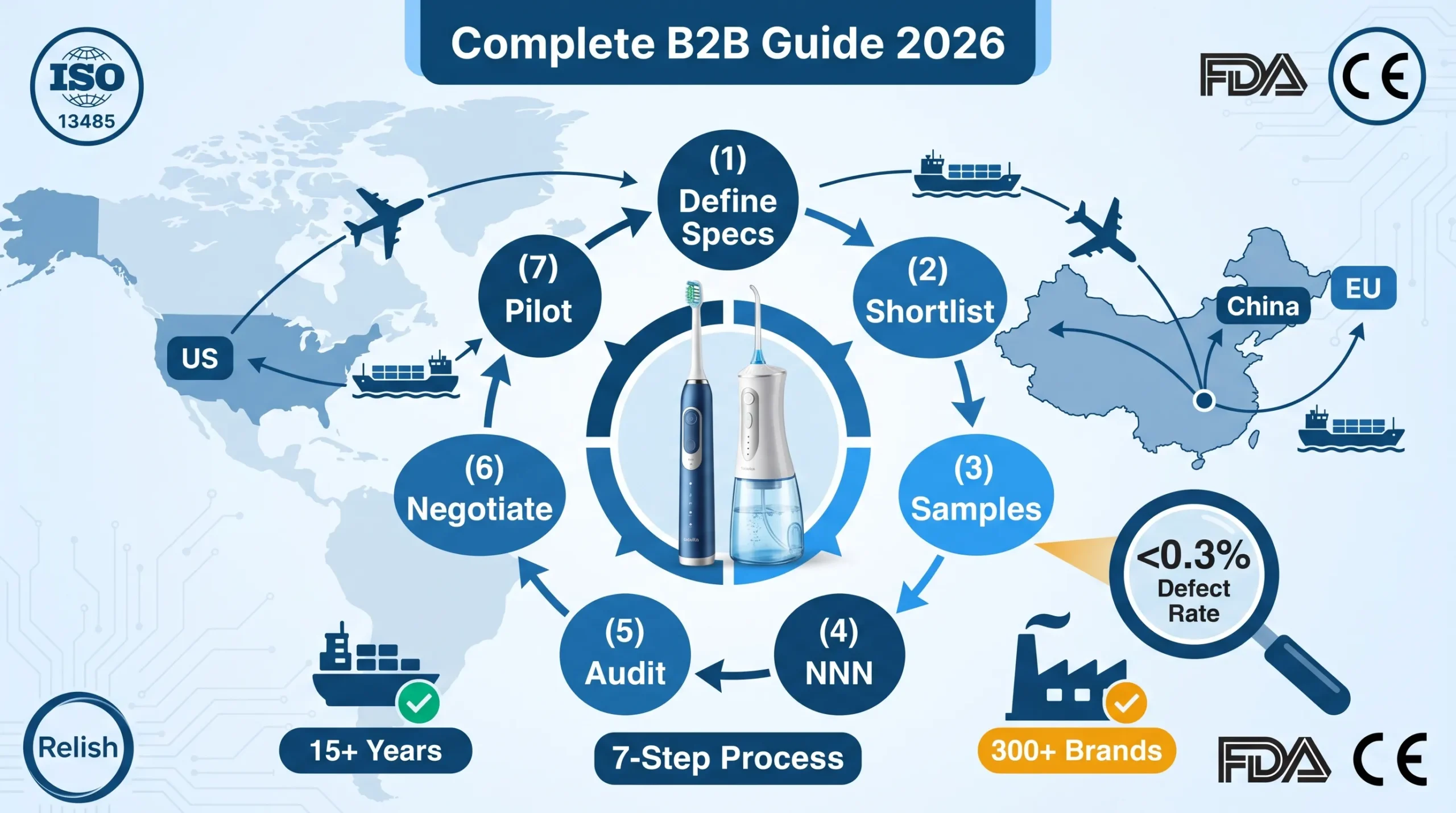
Wie man Mundpflegeprodukte aus China bezieht: 7-Schritte-Prozess
Dieser 7-Schritte-Leitfaden umfasst unser vollständiges Beschaffungsrahmenwerk. Für begleitende Ressourcen: 30-Punkte-Fabrikaudit-Checkliste | NNN-Vertragshandbuch | Qualitätskontrollprozess | Risikominderung in der Lieferkette | Produktionszentrum Shenzhen
Beschaffung von Mundpflegeprodukten aus China folgt einem strukturierten Prozess. Wenn Sie Schritte auslassen - insbesondere die Sorgfaltspflicht und den Schutz des geistigen Eigentums -, riskieren Sie kostspielige Fehler. Befolgen Sie diesen Rahmen jedes Mal.
Definieren Sie Ihre Produktspezifikationen und Ihren Zielmarkt
Bevor Sie sich an einen Hersteller wenden, sollten Sie Ihre Produktanforderungen dokumentieren: Art der Technologie (Schall/Oszillation/UV), Bürstenmodi, Batteriekapazität, IPX-Einstufung, angestrebter Verkaufspreis und Zielmarkt (USA/EU/Japan/andere). Ihr Zielmarkt bestimmt, welche Zertifizierungen erforderlich sind - dies bestimmt, welche Hersteller in Frage kommen.
Shortlist 3-5 Geprüfte Hersteller
Beschaffen Sie Kandidaten von Alibaba (Gold Supplier + Trade Assurance), Made-in-China, der Canton Fair und durch Branchenempfehlungen. Priorisieren Sie Fabriken mit: (a) ISO-13485-Zertifizierung, (b) mehr als 5 Jahren spezifischer Erfahrung im Bereich Mundpflege, (c) bestehenden Kunden aus westlichen Marken, (d) einem dedizierten Exportteam. Verlassen Sie sich niemals auf eine einzige Fabrik. Für einen umfassenderen Vergleich globaler Produktionsregionen und Verifizierungschecklisten siehe unseren Leitfaden für Mundpflegehersteller.
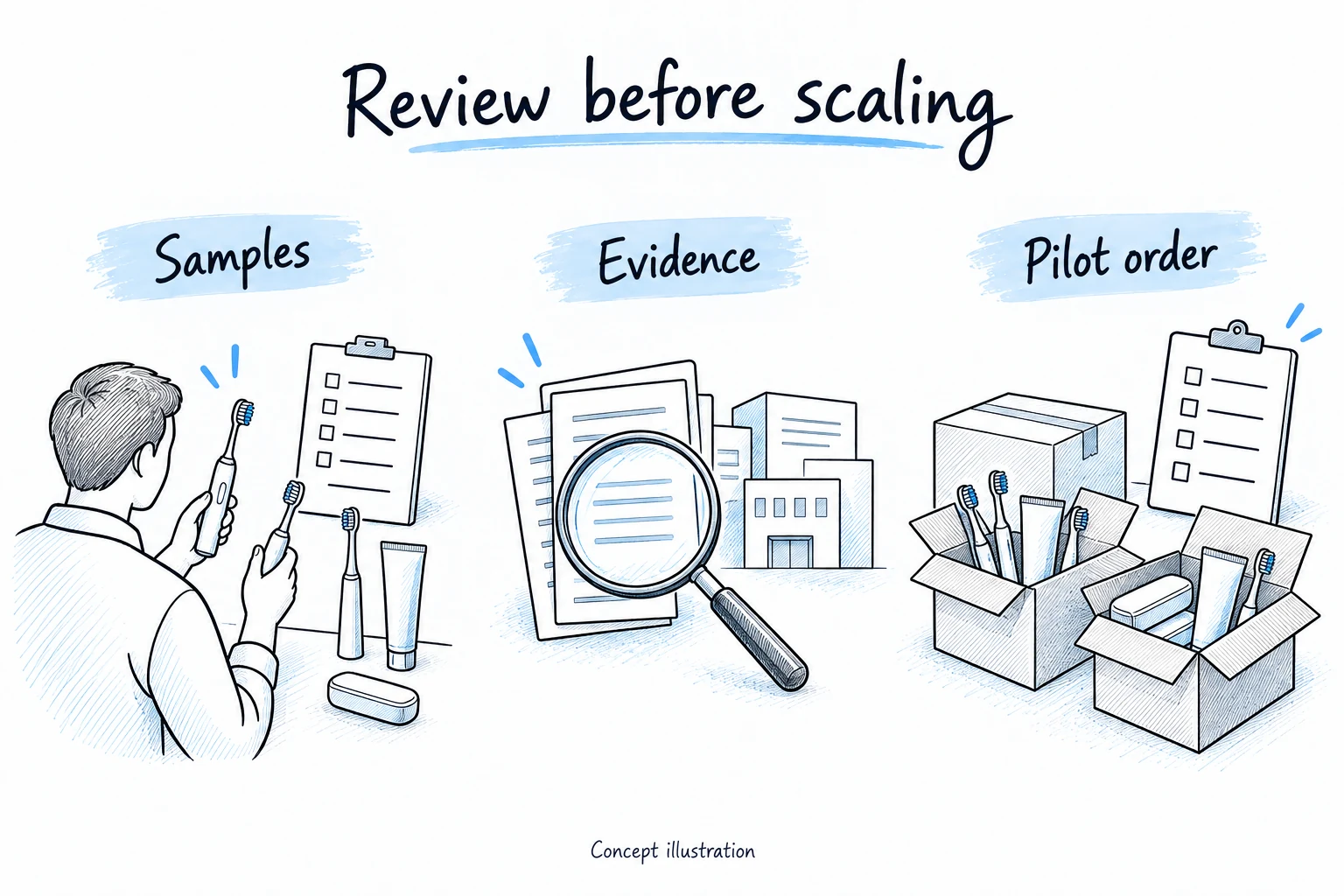
Muster und technische Dokumentation anfordern
Fragen Sie nach Produktmustern zusammen mit: ISO 13485-Zertifikat (überprüfen Sie das Verfallsdatum), Produktprüfberichten (UN 38.3 für Batterien, IEC 60335 für elektrische Sicherheit), CE/FDA-Dokumentation und einem abgeschlossenen QC-Inspektionsbericht (AQL 1,5 oder 2,5). Die Qualität der Proben ist das deutlichste Zeichen für die Qualität der Produktion.
Unterzeichnung einer NNN-Vereinbarung vor der gemeinsamen Nutzung von Designs
Eine NNN-Vereinbarung (Non-Disclosure, Non-Use, Non-Circumvention) regelt Ihre Beziehung nach chinesischem Recht und ist in China besser durchsetzbar als ein NDA nach amerikanischem Vorbild. Sprechen Sie mit Ihrem Hersteller über diese Vereinbarung, bevor Sie geschützte Designs, Formulierungen oder Technologien besprechen. Seriöse Hersteller unterzeichnen diese Vereinbarungen routinemäßig. Siehe unser Vollständiger Leitfaden für NNN-Vereinbarungen.
Durchführen eines Fabrik-Audits
Ein Fabrik-Audit - persönlich oder durch eine akkreditierte Drittpartei (SGS, Bureau Veritas, Intertek) - überprüft die Produktionskapazität, die Qualitätsmanagementsysteme, die Einhaltung der Arbeitsvorschriften und die Leistungsfähigkeit der Anlagen. Verwenden Sie eine strukturierte 30-Punkte-Checkliste. Siehe unser Checkliste für Fabrik-Audits in China. Dieser Schritt ist dringend empfohlen bei Bestellungen von mehr als 1.000 Stück.
Kommerzielle Bedingungen aushandeln
Die wichtigsten Bedingungen, die es auszuhandeln gilt, sind: (a) Stückpreisunterschiede bei den Mengenstufen, (b) Werkzeugkosten ($3.000-$25.000 für kundenspezifische Formen), (c) Zahlungsbedingungen (30% Anzahlung, 70% vor Versand ist Standard), (d) Musterkosten und Vorlaufzeiten, (e) Garantie- und Defektaustauschpolitik. Dokumentieren Sie alles in einer formellen OEM-Herstellungsvereinbarung.
Erteilen Sie einen Pilotauftrag vor der vollen Produktion
Erteilen Sie einen Pilotauftrag über 300-500 Einheiten, um die Qualität der Produktion, die Genauigkeit der Verpackung und die Lieferzuverlässigkeit zu überprüfen, bevor Sie sich zu großen Mengen verpflichten. Vereinbaren Sie für Pilotaufträge eine Inspektion vor der Auslieferung. Die Kosten für $300-500 für die Inspektion überwiegen bei weitem das Risiko, einen vollen Container bei der Ankunft zurückzuweisen.
Erforderliche Zertifizierungen für aus China stammende Mundpflegeprodukte
Mundpflegeprodukte - insbesondere elektrische Zahnbürsten und Zahnseidegeräte - fallen je nach Zielmarkt unter unterschiedliche rechtliche Rahmenbedingungen. Wenn Beschaffung von Mundpflegeprodukten aus China, Ihr chinesischer Hersteller sollte Sie bei diesem Prozess unterstützen. Siehe unser Leitfaden für vollständige Zertifizierungen für detaillierte Anforderungen.
If the table is not fully visible, scroll horizontally to view all columns.
| Markt | Erforderliche Zertifizierung | Anwendbare Produkte | Zeitleiste | Wer Dateien |
|---|---|---|---|---|
| Vereinigte Staaten | FDA-Registrierung (21 CFR Teil 880) | Elektrische Zahnbürsten (Klasse II) | 3-6 Monate | Markeninhaber (US-Agent) |
| Europäische Union | CE-Kennzeichnung (LVD + EMC) | Elektrische Mundpflege | 2-4 Monate | EU-Bevollmächtigter |
| Global (Qualität) | ISO 13485 | Herstelleranforderung | Laufend | Hersteller |
| UK (Post-Brexit) | UKCA-Kennzeichnung | Elektrische Mundpflege | 2-4 Monate | UK Verantwortliche Person |
| Japan | PSE-Zeichen (METI) | Elektrische Zahnbürsten | 3-6 Monate | Japan-Importeur |
| Australien | RCM-Markierung | Alle eingeschalteten Geräte | 2-3 Monate | Australischer Importeur |
Sourcing Mundpflege aus China? Erhalten Sie ein Angebot innerhalb von 48 Stunden
Relish Technology - FDA registriert, CE zertifiziert, ISO 13485. Seit über 15 Jahren Herstellung von elektrischen Zahnbürsten und Zahnseidegeräten in Shenzhen. NNN-Vereinbarung verfügbar, bevor wir ein Design teilen.
Werksangebot anfordern →Schutz des geistigen Eigentums bei der Beschaffung aus China
Der Schutz des geistigen Eigentums ist die von westlichen Markeninhabern am häufigsten geäußerte Sorge. Das Risiko ist real - aber mit dem richtigen Ansatz überschaubar. Wenn Beschaffung von Mundpflegeprodukten aus China, Die Durchsetzung von Rechten des geistigen Eigentums in China hat sich deutlich verbessert: Das Gericht für geistiges Eigentum in Shenzhen bearbeitete über 18.000 IP-Fälle im Jahr 2024, wobei ausländische Kläger die Mehrheit der vollständig angefochtenen Fälle gewinnen (MOFCOM, 2024).
Der 4-Schichten-Rahmen für den Schutz des geistigen Eigentums
Wenn Beschaffung von Mundpflegeprodukten aus China, verwenden Sie diesen vierstufigen Rahmen, um Ihre Designs und Markenwerte in jeder Phase zu schützen:
- NNN-Vertrag zuerst: Lassen Sie Ihren Hersteller vor der gemeinsamen Nutzung von Entwürfen eine NNN-Vereinbarung unterzeichnen, die dem chinesischen Recht (nicht dem US-Recht) unterliegt. Dies verhindert die Offenlegung, unbefugte Nutzung und Umgehung - alle drei Vektoren des IP-Risikos.
- Registrieren Sie Marken direkt in China: Wenn Beschaffung von Mundpflegeprodukten aus China, Denken Sie daran, dass China ein Land ist, in dem die Anmeldung zuerst erfolgt. Registrieren Sie Ihren Markennamen und Ihr Logo bei der China National Intellectual Property Administration (CNIPA), bevor Sie sich an Hersteller wenden. Kosten: $300-800/Klasse.
- Gebrauchspatente für funktionelle Innovationen: Wenn Ihr Produkt einen neuartigen Mechanismus aufweist, melden Sie ein Gebrauchsmuster bei der CNIPA an ($500-2.000 bei einer lokalen IP-Firma). Gebrauchsmuster gewähren 10 Jahre Schutz und sind schneller zu erhalten als Erfindungspatente.
- Segmentierung der Lieferkette: Vermeiden Sie es, einem einzigen Lieferanten Ihre kompletten Produktspezifikationen zu geben. Beziehen Sie wichtige Komponenten von verschiedenen Lieferanten, wobei die Endmontage bei einem vertrauenswürdigen Partner erfolgen sollte. Dadurch wird das Risiko auf jeder Ebene begrenzt.
Qualitätskontrolle: Was Sie von einem chinesischen Spitzenhersteller erwarten können
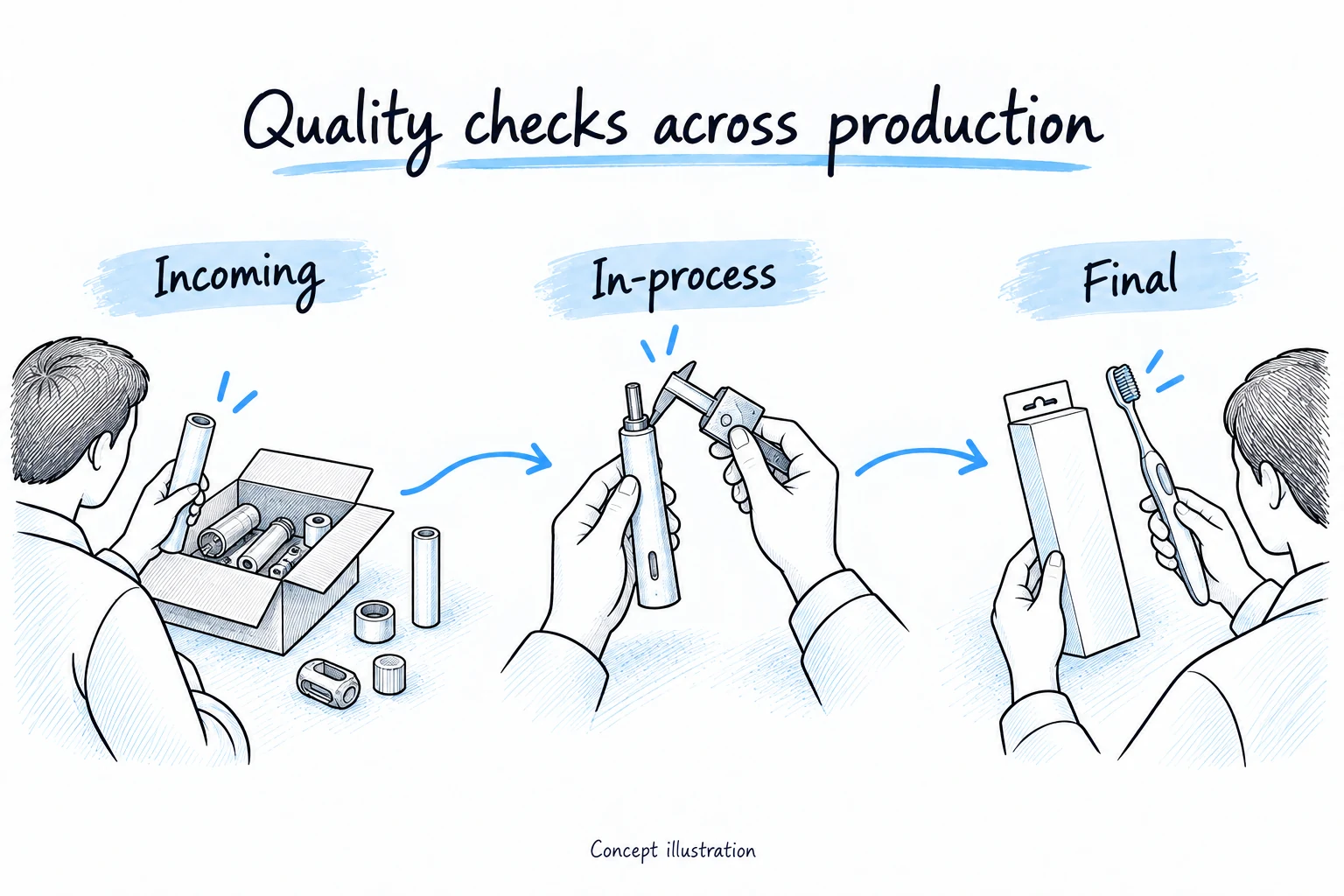
Qualitätsabweichungen sind das größte Risiko, wenn Beschaffung von Mundpflegeprodukten aus China. Top-Tier ISO 13485-zertifizierte Hersteller liefern Fehlerraten unter 0,3% - vergleichbar mit europäischen Produktionsstandards. Tier-2-Fabriken haben durchschnittlich 1-3%. Der Unterschied liegt in ihren Qualitätsmanagementsystemen.
Materialeingangsprüfung (IQC)
Klassenbeste Fabriken, wenn Beschaffung von Mundpflegeprodukten aus China 100% der eingehenden Motoren, Batterien und Leiterplatten vor der Freigabe zur Produktion anhand der technischen Spezifikationen zu überprüfen. Lieferanten, die 3 aufeinanderfolgende Inspektionen nicht bestehen, werden von der Liste gestrichen. Für Mundpflege OEM, lesen Sie unsere Leitfaden für die OEM-Qualitätskontrolle für jede Phase.
Prozessbegleitende Qualitätskontrolle (IPQC)
Die automatisierte optische Inspektion (AOI) und die statistische Prozesskontrolle (SPC) auf jeder Produktionsstufe erfassen Fehler in Echtzeit. Achten Sie auf Fabriken mit standardmäßigen AQL 1,5 Stichprobenplänen (nicht AQL 4,0, bei dem wesentlich mehr Fehler übersehen werden).
Endkontrolle (OQC)
Wenn Beschaffung von Mundpflegeprodukten aus China, Die 100%-Funktionsprüfung jeder elektrischen Zahnbürste und Zahnseide - Vibrationsfrequenz, Wasserdichtigkeit (IPX5- oder IPX7-Tauchtest), Batterieleistung und Unversehrtheit der Verpackung - ist der Standard bei Spitzenherstellern. Bei Bestellungen von mehr als 1.000 Stück wird eine Inspektion vor dem Versand durch eine dritte Partei (SGS, Bureau Veritas) dringend empfohlen.
Zeitplan und Logistikplanung
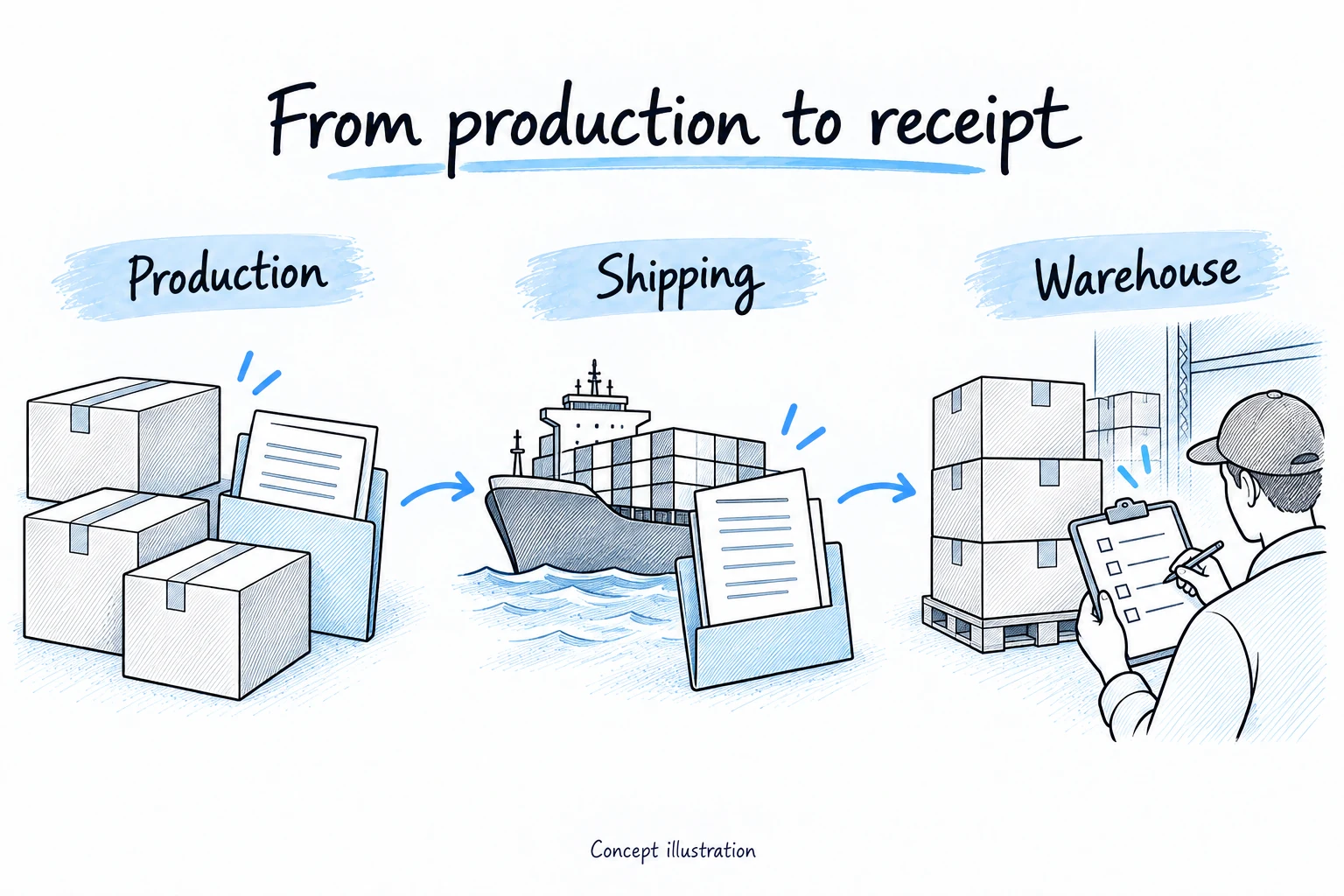
Beschaffung von Mundpflegeprodukten aus China erfordert eine genaue Zeitplanung, um kostspielige Lagerbestände und Verzögerungen bei der Markteinführung zu vermeiden. Nutzen Sie diesen Rahmen für die Einführung neuer elektrischer Zahnbürsten oder Zahnseideprodukte:
If the table is not fully visible, scroll horizontally to view all columns.
| Phase | Tätigkeit | Dauer | Anmerkungen |
|---|---|---|---|
| Monat 1 | Auswahlverfahren für Fabriken, Muster, NNN-Vertrag | 3-4 Wochen | 3+ Fabriken parallel betreiben |
| Monat 2 | Stichprobenprüfung, Betriebsprüfung, Geschäftsverhandlungen | 3-4 Wochen | Buchen Sie die Prüfung frühzeitig; die Prüfer haben eine Vorlaufzeit von 2-3 Wochen |
| Monat 3 | Unterzeichnung der OEM-Vereinbarung, Bestätigung von Werkzeugen und Design | 2-3 Wochen | Werkzeugbau für kundenspezifische Gussformen: 3-5 Wochen |
| Monat 3-4 | Nullserie (300-500 Einheiten) | 3-4 Wochen | Zeitplan für die Inspektion vor dem Versand |
| Monat 4-5 | Vollständiger Produktionsauftrag | 30-45 Tage | Kundenspezifische ODM: 60-90 Tage |
| +30 Tage | Seefracht (Shenzhen → US-Westküste) | 14-18 Tage | Luftfracht: 5-7 Tage, 4-6x Kosten |
| +30 Tage | Zollabfertigung + Lagerempfang | 7-14 Tage | 3 Wochen Puffer für den Zoll einplanen |
Die Wahl des richtigen Herstellers: OEM vs. ODM
Die Unterscheidung zwischen OEM und ODM ist von entscheidender Bedeutung, wenn Beschaffung von Mundpflegeprodukten aus China - er gestaltet Ihren Projektumfang und Ihr Budget von Anfang an richtig.
If the table is not fully visible, scroll horizontally to view all columns.
| Modell | Wer ist Eigentümer des Designs | Anpassungsgrad | MOQ | Kosten | Zeitleiste |
|---|---|---|---|---|---|
| OEM (rein) | Markeneigentümer liefert vollständiges Design | Maximum | 2,000–10,000 | Werkzeuge: $5,000–$30,000 | 60-120 Tage |
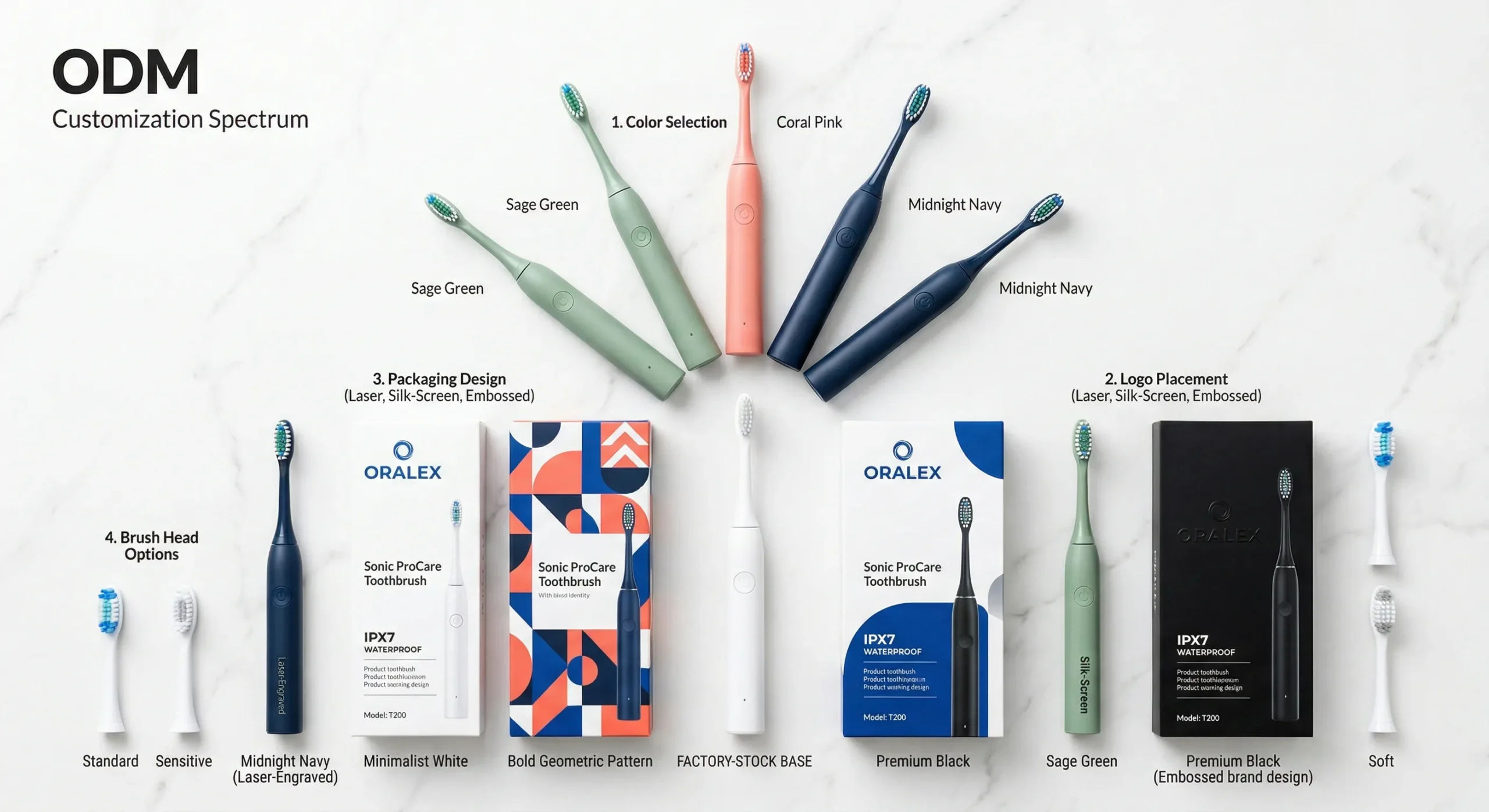
| ODM (schlüsselfertig) | Der Hersteller besitzt das Basisdesign | Logo, Farbe, Verpackung | 500–3,000 | Minimale Werkzeugausstattung | 30-60 Tage |
| Eigenmarke | Dem Hersteller gehört alles | Nur Etikett und Verpackung | 300–1,000 | Keine | 15-30 Tage |
Die meisten neuen Marken beginnen mit ODM oder Eigenmarke um die Marktnachfrage zu validieren, bevor Sie in eigene Werkzeuge investieren. Sobald Ihre Marke an Zugkraft gewinnt, kann der Übergang zu einer vollständigen OEM-Produktion mit kundenspezifischer Technologie (wie Relishs Vibrosonic™- oder Rotasonic™-Plattformen) schafft eine vertretbare Differenzierung, die Konkurrenten nicht so leicht kopieren können.
Rote Flaggen: Wann man sich von einem chinesischen Hersteller abwenden sollte
Wenn Beschaffung von Mundpflegeprodukten aus China, sind bestimmte Warnzeichen eindeutig. Achten Sie in jeder Phase des Beschaffungsprozesses auf diese Warnsignale:
- Weigert sich, eine NNN-Vereinbarung zu unterzeichnen: Wenn Beschaffung von Mundpflegeprodukten aus China, Ein seriöser Betrieb schließt routinemäßig NNN-Verträge ab. Eine Weigerung ist ein deutliches Warnsignal.
- Sie können keine Originalbescheinigungen (keine Kopien) vorlegen: Fordern Sie das Originalzertifikat auf der Website der ausstellenden Stelle an. Es gibt gefälschte ISO-Zertifikate.
- MOQ ungewöhnlich niedrig und ohne Erklärung: MOQs unter 300 Stück für kundenspezifische Produkte deuten oft auf ein Handelsunternehmen hin, nicht auf eine Fabrik.
- Keine feste Betriebsanschrift oder nachprüfbare Räumlichkeiten: Vergewissern Sie sich immer, dass die physische Adresse der Fabrik über die Satellitenansicht von Google Maps mit den Produktionsfotos übereinstimmt.
- Die Muster kommen mit anderen Spezifikationen an als angegeben: Dies deutet entweder auf die Vergabe von Unteraufträgen oder auf eine absichtliche Täuschung hin.
- Angebote, die 30%+ unter dem Marktpreis liegen: Ungewöhnlich niedrige Preise bedeuten in der Regel minderwertige Komponenten, die Sie später durch Rücksendungen und Kundenbeschwerden bezahlen werden.
Häufig gestellte Fragen
Häufige Fragen, wenn Beschaffung von Mundpflegeprodukten aus China - von der Überprüfung im Werk bis hin zu Zertifizierungen, IP-Schutz und Vorlaufzeiten:
Sind Sie bereit, Mundpflegeprodukte aus China zu beziehen?
Relish Technology - mehr als 15 Jahre OEM/ODM-Herstellung in Shenzhen. FDA-registriert, CE-zertifiziert, ISO 13485. Fordern Sie noch heute Muster und eine Einladung zum Betriebsaudit an.
Werksangebot anfordern →Referenzen und Quellen
- Grand View Research. (2025). Markt für elektrische Zahnbürsten - Bericht über Größe und Wachstum, 2025-2030. Grand View Research Inc. Abgerufen von https://www.grandviewresearch.com/industry-analysis/oral-care-market
- Internationale Organisation für Normung. (2016). ISO 13485:2016 - Medizinprodukte - Qualitätsmanagementsysteme - Anforderungen für Regulierungszwecke. ISO. Abgerufen von https://www.iso.org/standard/54934.html
- U.S. Food & Drug Administration. (2024). Dentalprodukte der Klasse II: Elektrische Zahnbürste (21 CFR Teil 880). FDA.gov. Abgerufen von https://www.fda.gov/medical-devices/class-ii-special-controls-and-class-ii-devices/electrically-operated-dental-handpiece-systems-class-ii-special-controls
- Handelsministerium der Volksrepublik China. (2024). Jahresbericht über den Schutz des geistigen Eigentums in China, 2024. MOFCOM. Abgerufen von https://english.mofcom.gov.cn/
- Gericht für geistiges Eigentum in Shenzhen. (2024). Jährliche Statistik über Rechtsstreitigkeiten im Bereich des geistigen Eigentums, 2024. Abgerufen von https://www.sz.gov.cn/cn/xxgk/zfxxgj/zcfg/
- Statista Forschungsabteilung. (2025). Globaler Markt für Auftragsfertigung von Mundpflegeprodukten - Regionaler Produktionsanteil 2024. Statista. Abgerufen von https://www.statista.com/topics/4834/shenzhen/
- Amerikanische Zahnärztevereinigung. (2023). Elektrische Zahnbürste: Zusammenfassung der Wirksamkeitsnachweise. ADA.org. Abgerufen von https://www.ada.org/resources/research/science-and-research-institute/oral-health-topics/powered-toothbrushes